


How the New EU Entry Requirements (EES/ETIAS) Could Strand American Travelers in 2026
If you've been planning a trip to Europe this year or next, there are two things you absolutely need to know before you book anything. The European Union has rolled out two brand-new border management systems, and together they're already causing real problems for American travelers. We're talking about missed flights, some travelers have reported waits of up to four hours during peak periods at passport control, and in some cases, operational issues and data mismatches have raised concerns about travelers potentially being incorrectly flagged for overstays.
This isn't fearmongering. Early implementation has already led to delays and operational challenges at several major airports, and it's going to get more complicated before it gets easier.
Let's break it down.

The Two Systems You Need to Know About
EES: Already Live, Already Causing Delays
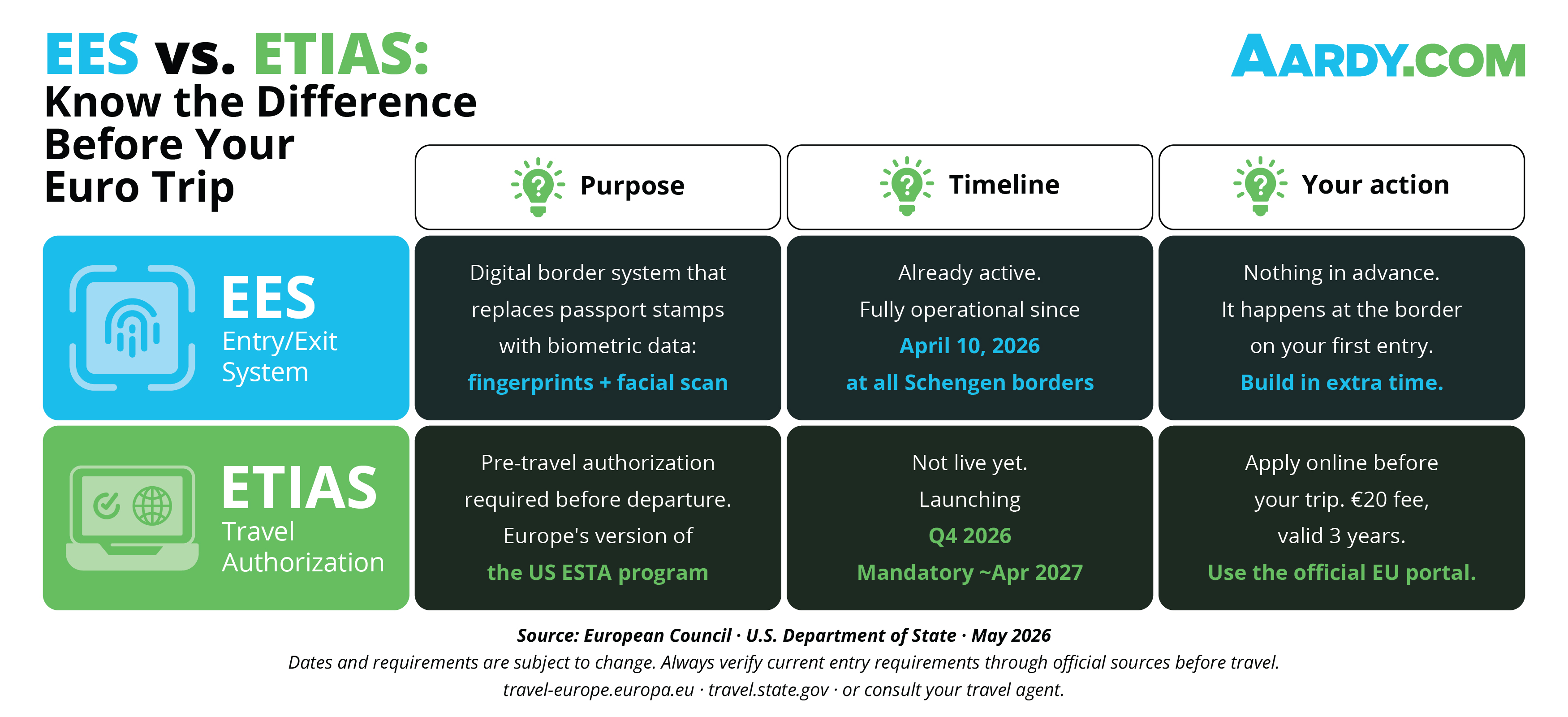
The Entry/Exit System, better known as EES, is Europe's way of saying goodbye to passport stamps forever. It launched on October 12, 2025, and as of April 10, 2026, it is fully operational at all external border crossing points across the 29 Schengen member states.
What does that actually mean for you at the airport? When you arrive in Europe for the first time under this system, you'll need to scan your passport, provide fingerprints, and have a photo taken before seeing a border officer. Your biometric data gets stored digitally and linked to your travel history across all participating countries.
The idea is smart on paper. In practice, it's been a headache.
Airports in Portugal and Italy, which serve as primary gateways for international tourists, have experienced some of the most significant disruptions since the rollout. In Portugal, airports in Lisbon, Porto, and Faro have seen waiting times at border control climb to between two and three hours during peak periods. And that's not even the worst of it. France, Italy, Spain, and Portugal have seen operational breakdowns, with passengers reporting up to 4-hour waits at immigration.
The good news? Once your data is in the system, future entries should be faster. The bottleneck is that first registration, and right now millions of travelers are all hitting that step at the same time.
ETIAS: Coming Later in 2026, But You Should Start Paying Attention Now
If EES is the system you're dealing with today, ETIAS is the one you need to prepare for before your next trip.
ETIAS will require citizens from 59 visa-exempt countries, including the US, to obtain authorization before traveling to 30 European countries. Think of it as Europe's equivalent of the US ESTA program.
The European Council has formally confirmed that ETIAS will launch in Q4 2026, meaning October through December. The exact date will be announced several months in advance. So if you're traveling to Europe in the spring or summer of 2026, you don't need to worry about it yet. But if you're planning anything for the fall or holiday season, this is going to affect you.
Here's what the process will look like:
-You'll apply online and provide your full name, birthdate, passport details, travel plans, and answer security and background questions related to criminal convictions, prior travel to conflict zones, and certain public health risks.
-Americans between the ages of 18 and 70 will pay a €20 fee. Travelers outside that age range won't need to pay, but they still need to apply.
-The authorization will be valid for up to three years or until your passport expires, whichever comes first.
One critical thing to know: if you have a residence permit or card from a European country that otherwise requires ETIAS, you do not need to apply.
The Scenarios Where Things Go Wrong
This is where it gets important for travelers who like to plan tightly. Here are the situations where the new systems create real risk.
-Missed connections at major hubs. If you are transiting through a Schengen hub, such as Frankfurt or Amsterdam, and your first entry falls under EES, you should ensure your layover is at least 3 hours. If you miss a connection due to EES delays on a single-ticket itinerary, airlines are legally required to rebook you. But that doesn't help when you're stuck in a 3-hour queue watching your connection board and take off.
-Being wrongly flagged as an overstay. This has already happened to real travelers. There have been operational issues with EES, including cases where travelers were incorrectly flagged as having overstayed their visa-free allowance. Errors in the system can take time to resolve, and being denied entry to the Schengen Area is not the way you want to start a vacation.
-Showing up for ETIAS-required travel without authorization. Once ETIAS goes live, there will be a transitional grace period of roughly six months during which you may still be admitted without ETIAS at border discretion. But by around April 2027, that window closes and ETIAS becomes mandatory. Don't count on being waved through.
-UK travel is a separate matter entirely. This is a common source of confusion. The UK implemented its own Electronic Travel Authorization (ETA) on February 25, 2026, and it must be obtained separately before traveling there. If you're combining a UK trip with a European one, you need both authorizations. They don't overlap.
What Smart Travelers Are Doing Right Now
Anyone entering the Schengen Area for the first time under EES should avoid short connections, build in wider buffers, arrive prepared for biometric registration, and expect longer processing times during busy travel periods.
A few practical steps worth taking today:
-Build time buffers into your itinerary. Treat border control as a major item in your schedule, not a formality. If you're arriving at a large hub and have plans later that day, rethink the timeline.
-Check your passport expiration date. Since ETIAS is tied to your passport, renewing your travel document resets the authorization clock. Make sure your travel plans align with your document's validity.
-Bookmark the official ETIAS portal now. When the system opens later this year, unofficial third-party sites that mimic the look of government portals have already begun to appear, often charging inflated fees for a service you can complete in minutes for a fraction of the cost through official channels.
-Apply for ETIAS well before departure. Give yourself at least 72 hours before departure in case processing takes longer, especially during demand surges or if your application requires additional screening.

What Does This Have to Do With Your Travel Insurance?
More than you might think.
Europe is not suddenly off-limits for American travelers, but the adjustment period in 2026 is real. EES delays are already causing missed connections and disrupted itineraries, and many travelers don't realize that documentation errors, an expired passport, or a missing ETIAS authorization may not be covered under standard policies.
Before you travel, it's worth asking the right questions: Does your policy cover trip interruption caused by border delays? What happens if your ETIAS application is denied?
That's exactly where AARDY comes in. When you shop through AARDY, you get a huge selection of policies from the most trusted names in travel insurance, all with guaranteed best pricing. You will not find the same policy at a better price anywhere else. For a season where border surprises are very much on the table, that's not just a nice perk. It's the smartest way to make sure you're covered without overpaying for it. Europe is waiting. Just make sure your insurance is ready before you are.
Compare travel insurance plans for your 2026 European trip at AARDY.com and travel with confidence.
*Travel regulations change fast, and the EES and ETIAS rollout is still evolving. The information in this article is based on the latest available data as of May 2026, but entry requirements, fees, and timelines can be updated with little notice. Before you book or travel, we strongly recommend confirming current requirements directly with your travel agent, the official EU portal, or the U.S. Department of State website. *
Coverage for denied boarding, documentation issues, or travel interruptions varies between insurers.
This article has been written for review purposes only and does not suggest sponsorship or endorsement of AARDY by the trademark owner.
Recent AARDY Travel Insurance Customer Reviews

Debbie Reiter

The young lady was very helpful and had…
The young lady was very helpful and had answers to all my questions. She knows her job very well… Professional and very friendly!!!!
customer
Service was prompt and responsive!
Service was prompt and responsive!
JW
Great options
I have used this service several times. it's very easy to use and provides a lot of options. I have never had to make a claim, so not certain how that process works.