


Laos Country Information
Travel Advice with Country Information from the CIA.
At AARDY.COM we can’t recommend travel insurance enough. Whether you are just traveling a few hundred miles from home to see family, or traveling to the other side of the world, travel insurance should be considered an essential part of your holiday packing. The hope is that you won’t have to use your travel insurance, and that you’ll have a fun and enjoyable trip. The following Laos Information should help you make the most of your trip to Laos.
Note: Always check that your destination country is one approved for travel by your travel insurance provider.
Introduction
Background
Modern-day Laos has its roots in the ancient Lao kingdom of Lan Xang, established in the 14th century under King FA NGUM. For 300 years Lan Xang had influence reaching into present-day Cambodia and Thailand, as well as over all of what is now Laos. After centuries of gradual decline, Laos came under the domination of Siam (Thailand) from the late 18th century until the late 19th century, when it became part of French Indochina. The Franco-Siamese Treaty of 1907 defined the current Lao border with Thailand. In 1975, the communist Pathet Lao took control of the government, ending a six-century-old monarchy and instituting a strict socialist regime closely aligned to Vietnam. A gradual, limited return to private enterprise and the liberalization of foreign investment laws began in 1988. Laos became a member of ASEAN in 1997 and the WTO in 2013.
In the 2010s, the country benefited from direct foreign investment, particularly in the natural resource and industry sectors. Construction of a number of large hydropower dams and expanding mining activities have also boosted the economy. Laos has retained its official commitment to communism and maintains close ties with its two communist neighbors, Vietnam and China, both of which continue to exert substantial political and economic influence on the country. China, for example, is providing 70% of the funding for a $5.9 billion, 400-km railway line between the Chinese border and the capital Vientiane, which is set for completion in 2021. Laos is financing the remaining 30% with loans from China. At the same time, Laos has expanded its economic reliance on the West and other Asian countries, such as Japan, Malaysia, Singapore, Taiwan, and Thailand.
Geography
Location
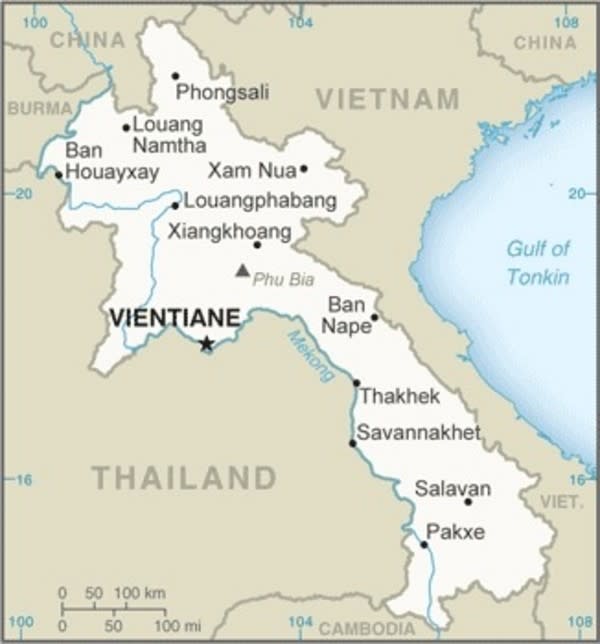
Southeastern Asia, northeast of Thailand, west of Vietnam
Geographic coordinates
18 00 N, 105 00 E
Map references
Southeast Asia
Area
total: 236,800 sq km
land: 230,800 sq km
water: 6,000 sq km
country comparison to the world: 84
Area - comparative
about twice the size of Pennsylvania; slightly larger than Utah
Land boundaries
total: 5,274 km
border countries (5): Burma 238 km, Cambodia 555 km, China 475 km, Thailand 1845 km, Vietnam 2161 km
Coastline
0 km (landlocked)
Maritime claims
none (landlocked)
Climate
tropical monsoon; rainy season (May to November); dry season (December to April)
Terrain
mostly rugged mountains; some plains and plateaus
Elevation
highest point: Phu Bia 2,817 m
lowest point: Mekong River 70 m
mean elevation: 710 m
Natural resources
timber, hydropower, gypsum, tin, gold, gemstones
Land use
agricultural land: 10.6% (2018 est.)
arable land: 6.2% (2018 est.)
permanent crops: 0.7% (2018 est.)
permanent pasture: 3.7% (2018 est.)
forest: 67.9% (2018 est.)
other: 21.5% (2018 est.)
Irrigated land
3,100 sq km (2012)
Major watersheds (area sq km)
Pacific Ocean drainage: Mekong (805,604 sq km)
Major rivers (by length in km)
Mekong (shared with China [s], Burma, Thailand, Cambodia, and Vietnam [m]) - 4,350 km
note – [s] after country name indicates river source; [m] after country name indicates river mouth
Population distribution
most densely populated area is in and around the capital city of Vientiane; large communities are primarily found along the Mekong River along the southwestern border; overall density is considered one of the lowest in Southeast Asia
Natural hazards
floods, droughts
Geography - note
landlocked; most of the country is mountainous and thickly forested; the Mekong River forms a large part of the western boundary with Thailand
People and Society
Population
7,574,356 (July 2021 est.)
country comparison to the world: 101
Nationality
noun: Lao(s) or Laotian(s)
adjective: Lao or Laotian
Ethnic groups
Lao 53.2%, Khmou 11%, Hmong 9.2%, Phouthay 3.4%, Tai 3.1%, Makong 2.5%, Katong 2.2%, Lue 2%, Akha 1.8%, other 11.6% (2015 est.)
note: the Laos Government officially recognizes 49 ethnic groups, but the total number of ethnic groups is estimated to be well over 200
Languages
Lao (official), French, English, various ethnic languages
major-language sample(s):
ແຫລ່ງທີ່ຂາດບໍ່ໄດ້ສຳລັບຂໍ້ມູນຕົ້ນຕໍ່” (Lao)
The World Factbook, the indispensable source for basic information.
Lao audio sample:
Religions
Buddhist 64.7%, Christian 1.7%, none 31.4%, other/not stated 2.1% (2015 est.)
Demographic profile
Laos is a predominantly rural country with a youthful population – almost 55% of the population is under the age of 25. Its progress on health and development issues has been uneven geographically, among ethnic groups, and socioeconomically. Laos has made headway in poverty reduction, with the poverty rate almost halving from 46% in 1992/93 to 22% in 2012/13. Nevertheless, pronounced rural-urban disparities persist, and income inequality is rising. Poverty most affects populations in rural and highland areas, particularly ethnic minority groups.
The total fertility rate (TFR) has decreased markedly from around 6 births per woman on average in 1990 to approximately 2.8 in 2016, but it is still one of the highest in Southeast Asia. TFR is higher in rural and remote areas, among ethnic minority groups, the less-educated, and the poor; it is lower in urban areas and among the more educated and those with higher incomes. Although Laos’ mortality rates have improved substantially over the last few decades, the maternal mortality rate and childhood malnutrition remain at high levels. As fertility and mortality rates continue to decline, the proportion of Laos’ working-age population will increase, and its share of dependents will shrink. The age structure shift will provide Laos with the potential to realize a demographic dividend during the next few decades, if it can improve educational access and quality and gainfully employ its growing working-age population in productive sectors. Currently, Laos primary school enrollment is nearly universal, but the drop-out rate remains problematic. Secondary school enrollment has also increased but remains low, especially for girls.
Laos has historically been a country of emigration and internal displacement due to conflict and a weak economy. The Laos civil war (1953 – 1975) mainly caused internal displacement (numbering in the hundreds of thousands). Following the end of the Vietnam War in 1975, indigenous people in remote, war-struck areas were resettled and more than 300,000 people fled to Thailand to escape the communist regime that took power. The majority of those who sought refuge in Thailand ultimately were resettled in the US (mainly Hmong who fought with US forces), and lesser numbers went to France, Canada, and Australia.
The Laos Government carried out resettlement programs between the mid-1980s and mid-1990s to relocate ethnic minority groups from the rural northern highlands to development areas in the lowlands ostensibly to alleviate poverty, make basic services more accessible, eliminate slash-and-burn agriculture and opium production, integrate ethnic minorities, and control rebel groups (including Hmong insurgents). For many, however, resettlement has exacerbated poverty, led to the loss of livelihoods, and increased food insecurity and mortality rates. As the resettlement programs started to wane in the second half of the 1990s, migration from the northern highlands to urban centers – chiefly the capital Vientiane – to pursue better jobs in the growing manufacturing and service sectors became the main type of relocation. Migration of villagers from the south seeking work in neighboring Thailand also increased. Thailand is the main international migration destination for Laotians because of the greater availability of jobs and higher pay than at home; nearly a million Laotian migrants were estimated to live in Thailand as of 2015.
Government
Country name
conventional long form: Lao People's Democratic Republic
conventional short form: Laos
local long form: Sathalanalat Paxathipatai Paxaxon Lao
local short form: Mueang Lao (unofficial)
etymology: name means "Land of the Lao [people]"
Government type
communist state
Capital
name: Vientiane (Viangchan)
geographic coordinates: 17 58 N, 102 36 E
time difference: UTC+7 (12 hours ahead of Washington, DC, during Standard Time)
etymology: the meaning in Pali, a Buddhist liturgical language, is "city of sandalwood"
Administrative divisions
17 provinces (khoueng, singular and plural) and 1 prefecture* (kampheng nakhon); Attapu, Bokeo, Bolikhamxai, Champasak, Houaphan, Khammouan, Louangnamtha, Louangphabang, Oudomxai, Phongsali, Salavan, Savannakhet, Viangchan (Vientiane)*, Viangchan, Xaignabouli, Xaisomboun, Xekong, Xiangkhouang
Independence
19 July 1949 (from France by the Franco-Lao General Convention); 22 October 1953 (Franco-Lao Treaty recognizes full independence)
National holiday
Republic Day (National Day), 2 December (1975)
Constitution
history: previous 1947 (preindependence); latest promulgated 13-15 August 1991
amendments: proposed by the National Assembly; passage requires at least two-thirds majority vote of the Assembly membership and promulgation by the president of the republic; amended 2003, 2015
Legal system
civil law system similar in form to the French system
International law organization participation
has not submitted an ICJ jurisdiction declaration; non-party state to the ICCt
Citizenship
citizenship by birth: no
citizenship by descent only: at least one parent must be a citizen of Laos
dual citizenship recognized: no
residency requirement for naturalization: 10 years
Suffrage
18 years of age; universal
Executive branch
chief of state: President THONGLOUN Sisoulit (since 22 March 2021); Vice President PANI Yathotou; Vice President BOUNTHONG Chitmani (since 22 March 2021)
head of government: Prime Minister PHANKHAM Viphavan (since 22 March 2021); Deputy Prime Ministers CHANSAMON Chan-gnalat, SONXAI Siphandon, KIKEO Khaikhamphithoun (since 22 March 2021)
cabinet: Council of Ministers appointed by the president, approved by the National Assembly
elections/appointments: president and vice president indirectly elected by the National Assembly for a 5-year term (no term limits); election last held on 22 March 2021; prime minister nominated by the president, elected by the National Assembly for 5-year term
election results:
2021: THONGLOUN Sisoulit (LPRP) elected president; National Assembly vote: 161-1; PANI Yathotou and BOUNTHONG Chitmani (LPRP) elected vice presidents; National Assembly vote NA; PHANKHAM Viphavan (LPRP) elected prime minister; National Assembly vote: 158-3
2016: BOUNNYANG Vorachit (LPRP) elected president; PHANKHAM Viphavan (LPRP) elected vice president; percent of National Assembly vote - NA; THONGLOUN Sisoulit (LPRP) elected prime minister; percent of National Assembly vote - NA
Legislative branch
description: unicameral National Assembly or Sapha Heng Xat (164 seats; members directly elected in multi-seat constituencies by simple majority vote from candidate lists provided by the Lao People's Revolutionary Party; members serve 5-year terms)
elections: last held on 21 February 2021 (next to be held in 2026)
election results: percent of vote by party - NA; seats by party - LPRP 158, independent 6; composition - men 128, women 36, percent of women 21.9%
Judicial branch
highest courts: People's Supreme Court (consists of the court president and organized into criminal, civil, administrative, commercial, family, and juvenile chambers, each with a vice president and several judges)
judge selection and term of office: president of People's Supreme Court appointed by the National Assembly upon the recommendation of the president of the republic for a 5-year term; vice presidents of the People's Supreme Court appointed by the president of the republic upon the recommendation of the National Assembly; appointment of chamber judges NA; tenure of court vice presidents and chamber judges NA
subordinate courts: appellate courts; provincial, municipal, district, and military courts
Political parties and leaders
Lao People's Revolutionary Party or LPRP [BOUNNYANG Vorachit]; Prime Minister THONGLOUN Sisoulit elected general secretary in mid-January 2021
note: other parties proscribed
International organization participation
ADB, ARF, ASEAN, CP, EAS, FAO, G-77, IAEA, IBRD, ICAO, ICRM, IDA, IFAD, IFC, IFRCS, ILO, IMF, Interpol, IOC, IPU, ISO (subscriber), ITU, MIGA, NAM, OIF, OPCW, PCA, UN, UNCTAD, UNESCO, UNIDO, UNWTO, UPU, WCO, WFTU (NGOs), WHO, WIPO, WMO, WTO
Diplomatic representation in the US
chief of mission: Ambassador KHAMPHAN Anlavan (since 21 July 2019)
chancery: 2222 S Street NW, Washington, DC 20008
telephone: [1] (202) 328-9148; [1] (202) 332-6416
FAX: [1] (202) 332-4923
email address and website:
embasslao@gmail.com; laoemb@verizon.net
https://laoembassy.com/
consulate(s): New York
Diplomatic representation from the US
chief of mission: Ambassador Peter HAYMOND (since 7 February 2020)
embassy: Ban Somvang Tai, Thadeua Road, Km 9, Hatsayfong District, Vientiane
mailing address: 4350 Vientiane Place, Washington DC 20521-4350
telephone: [856] 21-48-7000
FAX: [856] 21-48-7040
email address and website:
CONSLAO@state.gov
https://la.usembassy.gov/
Flag description
three horizontal bands of red (top), blue (double width), and red with a large white disk centered in the blue band; the red bands recall the blood shed for liberation; the blue band represents the Mekong River and prosperity; the white disk symbolizes the full moon against the Mekong River, but also signifies the unity of the people under the Lao People's Revolutionary Party, as well as the country's bright future
National symbol(s)
elephant; national colors: red, white, blue
National anthem
name: "Pheng Xat Lao" (Hymn of the Lao People)
lyrics/music: SISANA Sisane/THONGDY Sounthonevichit
note: music adopted 1945, lyrics adopted 1975; the anthem's lyrics were changed following the 1975 Communist revolution that overthrew the monarchy
Economy
Economic overview
The government of Laos, one of the few remaining one-party communist states, began decentralizing control and encouraging private enterprise in 1986. Economic growth averaged more than 6% per year in the period 1988-2008, and Laos' growth has more recently been amongst the fastest in Asia, averaging more than 7% per year for most of the last decade.
Nevertheless, Laos remains a country with an underdeveloped infrastructure, particularly in rural areas. It has a basic, but improving, road system, and limited external and internal land-line telecommunications. Electricity is available to 83% of the population. Agriculture, dominated by rice cultivation in lowland areas, accounts for about 20% of GDP and 73% of total employment. Recently, the country has faced a persistent current account deficit, falling foreign currency reserves, and growing public debt.
Laos' economy is heavily dependent on capital-intensive natural resource exports. The economy has benefited from high-profile foreign direct investment in hydropower dams along the Mekong River, copper and gold mining, logging, and construction, although some projects in these industries have drawn criticism for their environmental impacts.
Laos gained Normal Trade Relations status with the US in 2004 and applied for Generalized System of Preferences trade benefits in 2013 after being admitted to the World Trade Organization earlier in the year. Laos held the chairmanship of ASEAN in 2016. Laos is in the process of implementing a value-added tax system. The government appears committed to raising the country's profile among foreign investors and has developed special economic zones replete with generous tax incentives, but a limited labor pool, a small domestic market, and corruption remain impediments to investment. Laos also has ongoing problems with the business environment, including onerous registration requirements, a gap between legislation and implementation, and unclear or conflicting regulations.
Communications
Telephones - fixed lines
total subscriptions: 1,490,831 (2019)
subscriptions per 100 inhabitants: 20.79 (2019 est.)
country comparison to the world: 64
Telephones - mobile cellular
total subscriptions: 4,362,183 (2019)
subscriptions per 100 inhabitants: 60.84 (2019 est.)
country comparison to the world: 127
Telecommunication systems
general assessment: reliance on radio network to communicate with remote areas; regulatory reform is below industry standards; government aims to strengthen infrastructure and attract foreign investment; low fixed-broadband penetration; dominance in mobile broadband with 4G and LTE, but low compared to other Asian markets; ASEAN Digital Hub investment provides international capacity; state owns almost all media, except for some entertainment outlets, and has suppressed some news; importer of broadcasting equipment and computers from China; providers examining m-payment platforms and 5G tests (2020)
domestic: fixed-line 21 per 100 and 61 per 100 for mobile-cellular subscriptions (2019)
international: country code - 856; satellite earth station - 1 Intersputnik (Indian Ocean region) and a second to be developed by China
note: the COVID-19 pandemic continues to have a significant impact on production and supply chains globally; since 2020, some aspects of the telecom sector have experienced downturn, particularly in mobile device production; many network operators delayed upgrades to infrastructure; progress towards 5G implementation was postponed or slowed in some countries; consumer spending on telecom services and devices was affected by large-scale job losses and the consequent restriction on disposable incomes; the crucial nature of telecom services as a tool for work and school from home became evident, and received some support from governments
Broadcast media
6 TV stations operating out of Vientiane - 3 government-operated and the others commercial; 17 provincial stations operating with nearly all programming relayed via satellite from the government-operated stations in Vientiane; Chinese and Vietnamese programming relayed via satellite from Lao National TV; broadcasts available from stations in Thailand and Vietnam in border areas; multi-channel satellite and cable TV systems provide access to a wide range of foreign stations; state-controlled radio with state-operated Lao National Radio (LNR) broadcasting on 5 frequencies - 1 AM, 1 SW, and 3 FM; LNR's AM and FM programs are relayed via satellite constituting a large part of the programming schedules of the provincial radio stations; Thai radio broadcasts available in border areas and transmissions of multiple international broadcasters are also accessible
Internet country code
.la
Internet users
total: 1,845,437
percent of population: 25.51% (July 2018 est.)
country comparison to the world: 124
Broadband - fixed subscriptions
total: 76,280 (2019)
subscriptions per 100 inhabitants: 1.06 (2019 est.)
country comparison to the world: 130
Transportation
National air transport system
number of registered air carriers: 1 (2020)
inventory of registered aircraft operated by air carriers: 12
annual passenger traffic on registered air carriers: 1,251,961 (2018)
annual freight traffic on registered air carriers: 1.53 million mt-km (2018)
Civil aircraft registration country code prefix
RDPL
Airports
total: 41 (2013)
country comparison to the world: 104
Airports - with paved runways
total: 8
2,438 to 3,047 m: 3
1,524 to 2,437 m: 4
914 to 1,523 m: 1 (2017)
Airports - with unpaved runways
total: 33
1,524 to 2,437 m: 2
914 to 1,523 m: 9
under 914 m: 22 (2013)
Pipelines
540 km refined products (2013)
Roadways
total: 39,586 km (2009)
paved: 5,415 km (2009)
unpaved: 34,171 km (2009)
country comparison to the world: 90
Waterways
4,600 km (primarily on the Mekong River and its tributaries; 2,900 additional km are intermittently navigable by craft drawing less than 0.5 m) (2012)
country comparison to the world: 23
Merchant marine
total: 1
by type: general cargo 1 (2021)
country comparison to the world: 182
Military and Security
Military and security forces
Lao People's Armed Forces (LPAF): Lao People's Army (LPA, includes Riverine Force), Air Force, Self-Defense Militia Forces
Ministry of Public Security (internal security and law enforcement): local, traffic, immigration, and security police, as well as village police auxiliaries and other armed police units (2021)
Military expenditures
0.2% of GDP (2017 est.)
0.2% of GDP (2016 est.)
0.2% of GDP (2015 est.)
0.2% of GDP (2014 est.)
0.2% of GDP (2013 est.)
country comparison to the world: 166
Military and security service personnel strengths
information is limited and estimates for the size of the Lao People’s Armed Forces (LPAF) vary; approximately 30,000 active duty troops (26,000 Army; 4000 Air Force) (2020)
Military equipment inventories and acquisitions
the LPAF is armed largely with weapons from the former Soviet Union; since 2010, China and Russia are the leading suppliers of military equipment to Laos (2020)
Military service age and obligation
18 years of age for compulsory or voluntary military service; conscript service obligation - minimum 18 months (2019)
Military - note
the LPAF’s primary missions are border and internal security, including counterinsurgency and counterterrorism
Transnational Issues
Disputes - international
southeast Asian states have enhanced border surveillance to check the spread of avian flu; talks continue on completion of demarcation with Thailand but disputes remain over islands in the Mekong River; Cambodia and Laos have a longstanding border demarcation dispute; concern among Mekong River Commission members that China's construction of eight dams on the Upper Mekong River and construction of more dams on its tributaries will affect water levels, sediment flows, and fisheries; Cambodia and Vietnam are concerned about Laos' extensive plans for upstream dam construction for the same reasons
Illicit drugs
Bokeo Province part of the “Golden Triangle,” a notorious drug production and transit area; remains a poppy cultivator and source of illicit opium and a transit hub for other illicit drugs such as amphetamine-type stimulants (ATS) and chemical precursors; estimate of 4,925 ha of opium poppy cultivated in Laos in 2018
Recent AARDY Travel Insurance Customer Reviews
This article has been written for review purposes only and does not suggest sponsorship or endorsement of AARDY by the trademark owner.
Recent AARDY Travel Insurance Customer Reviews

Claudia Ramirez de Picazo

Very well explained and great service.
Very well explained and great service.
First time cruiser
Obtained travel insurance quotes thru AARP
Obtained travel insurance quotes thru AARP and after reviewing options, IMG offered the better options for the price. Revising my original quote was very easy and quick. DID NOT have to go thru ANY of the "do you want this or do you want that" options that would have added to the original quote. Just changed the amount of coverage I needed and was very simple and straight forward.
MBK
Both the chat staff and the agent that…
Both the chat staff and the agent that called me were very helpful. They answered all my questions and were efficient at the same time. Very pleased with their service.