


Pakistan Country Information
Travel Advice with Country Information from the CIA.
At AARDY.COM we can’t recommend travel insurance enough. Whether you are just traveling a few hundred miles from home to see family, or traveling to the other side of the world, travel insurance should be considered an essential part of your holiday packing. The hope is that you won’t have to use your travel insurance, and that you’ll have a fun and enjoyable trip. The following Pakistan Information should help you make the most of your trip to Pakistan.
Note: Always check that your destination country is one approved for travel by your travel insurance provider.
Introduction
Background
The Indus Valley civilization, one of the oldest in the world and dating back at least 5,000 years, spread over much of what is presently Pakistan. During the second millennium B.C., remnants of this culture fused with the migrating Indo-Aryan peoples. The area underwent successive invasions in subsequent centuries from the Persians, Greeks, Scythians, Arabs (who brought Islam), Afghans, and Turks. The Mughal Empire flourished in the 16th and 17th centuries; the British came to dominate the region in the 18th century. The separation in 1947 of British India into the Muslim state of Pakistan (with West and East sections) and largely Hindu India was never satisfactorily resolved, and India and Pakistan fought two wars and a limited conflict - in 1947-48, 1965, and 1999 respectively - over the disputed Kashmir territory. A third war between these countries in 1971 - in which India assisted an indigenous movement reacting to the marginalization of Bengalis in Pakistani politics - resulted in East Pakistan becoming the separate nation of Bangladesh.
In response to Indian nuclear weapons testing, Pakistan conducted its own tests in mid-1998. India-Pakistan relations improved in the mid-2000s but have been rocky since the November 2008 Mumbai attacks and have been further strained by attacks in India by militants believed to be based in Pakistan. Imran KHAN took office as prime minister in 2018 after the Pakistan Tehreek-e-Insaaf (PTI) party won a plurality of seats in the July 2018 general elections. Pakistan has been engaged in a decades-long armed conflict with militant groups that target government institutions and civilians, including the Tehreek-e-Taliban Pakistan (TTP) and other militant networks.
Geography
Location
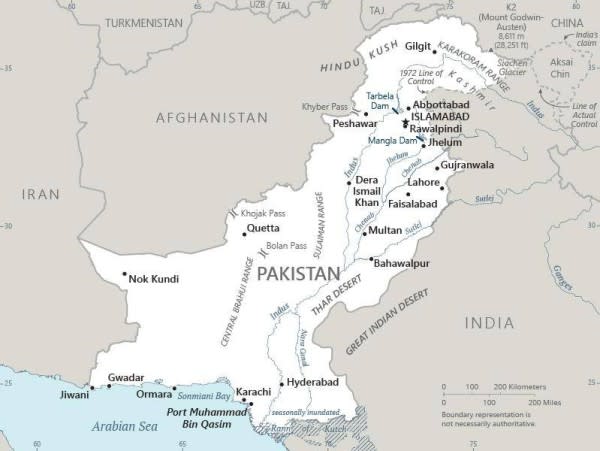
Southern Asia, bordering the Arabian Sea, between India on the east and Iran and Afghanistan on the west and China in the north
Geographic coordinates
30 00 N, 70 00 E
Map references
Asia
Area
total: 796,095 sq km
land: 770,875 sq km
water: 25,220 sq km
country comparison to the world: 37
Area - comparative
slightly more than five times the size of Georgia; slightly less than twice the size of California
Land boundaries
total: 7,257 km
border countries (4): Afghanistan 2,670 km; China 438 km; India 3,190 km; Iran 959 km
Coastline
1,046 km
Maritime claims
territorial sea: 12 nm
contiguous zone: 24 nm
exclusive economic zone: 200 nm
continental shelf: 200 nm or to the edge of the continental margin
Climate
mostly hot, dry desert; temperate in northwest; arctic in north
Terrain
divided into three major geographic areas: the northern highlands, the Indus River plain in the center and east, and the Balochistan Plateau in the south and west
Elevation
highest point: K2 (Mt. Godwin-Austen) 8,611 m
lowest point: Arabian Sea 0 m
mean elevation: 900 m
Natural resources
arable land, extensive natural gas reserves, limited petroleum, poor quality coal, iron ore, copper, salt, limestone
Land use
agricultural land: 35.2% (2018 est.)
arable land: 27.6% (2018 est.)
permanent crops: 1.1% (2018 est.)
permanent pasture: 6.5% (2018 est.)
forest: 2.1% (2018 est.)
other: 62.7% (2018 est.)
Irrigated land
202,000 sq km (2012)
Major rivers (by length in km)
Indus river mouth (shared with China [s] and India) - 3,610 km; Sutlej river mouth (shared with China [s] and India) - 1,372 km; Chenab river mouth (shared with India [s]) - 1,086 km
note – [s] after country name indicates river source; [m] after country name indicates river mouth
Major watersheds (area sq km)
Indian Ocean drainage: Indus (1,081,718 sq km)
Internal (endorheic basin) drainage: Tarim Basin (1,152,448 sq km), (Aral Sea basin) Amu Darya (534,739 sq km)
Major aquifers
Indus Basin
Population distribution
the Indus River and its tributaries attract most of the settlement, with Punjab province the most densely populated
Natural hazards
frequent earthquakes, occasionally severe especially in north and west; flooding along the Indus after heavy rains (July and August)
Geography - note
controls Khyber Pass and Bolan Pass, traditional invasion routes between Central Asia and the Indian Subcontinent
People and Society
Population
238,181,034 (July 2021 est.)
note: results of Pakistan's 2017 national census estimate the country's total population to be 207,684,626
country comparison to the world: 5
Nationality
noun: Pakistani(s)
adjective: Pakistani
Ethnic groups
Punjabi 44.7%, Pashtun (Pathan) 15.4%, Sindhi 14.1%, Saraiki 8.4%, Muhajirs 7.6%, Balochi 3.6%, other 6.3%
Languages
Punjabi 48%, Sindhi 12%, Saraiki (a Punjabi variant) 10%, Pashto (alternate name, Pashtu) 8%, Urdu (official) 8%, Balochi 3%, Hindko 2%, Brahui 1%, English (official; lingua franca of Pakistani elite and most government ministries), Burushaski, and other 8%
major-language sample(s):
ਸੰਸਾਰ ਦੀ ਤੱਥ ਕਿਤਾਬ, ਆਧਾਰੀ ਜਾਣਕਾਰੀ ਲਈ ਜ਼ਰੂਰੀ ਸਰੋਤ ਹੈ (Punjabi)
The World Factbook, the indispensable source for basic information.
Religions
Muslim (official) 96.5% (Sunni 85-90%, Shia 10-15%), other (includes Christian and Hindu) 3.5% (2020 est.)
Government
Country name
conventional long form: Islamic Republic of Pakistan
conventional short form: Pakistan
local long form: Jamhuryat Islami Pakistan
local short form: Pakistan
former: West Pakistan
etymology: the word "pak" means "pure" in Persian or Pashto, while the Persian suffix "-stan" means "place of" or "country," so the word Pakistan literally means "Land of the Pure"
Government type
federal parliamentary republic
Capital
name: Islamabad
geographic coordinates: 33 41 N, 73 03 E
time difference: UTC+5 (10 hours ahead of Washington, DC, during Standard Time)
etymology: derived from two words: "Islam," an Urdu word referring to the religion of Islam, and "-abad," a Persian suffix indicating an "inhabited place" or "city," to render the meaning "City of Islam"
Administrative divisions
4 provinces, 2 Pakistan-administered areas*, and 1 capital territory**; Azad Kashmir*, Balochistan, Gilgit-Baltistan*, Islamabad Capital Territory**, Khyber Pakhtunkhwa, Punjab, Sindh
Independence
14 August 1947 (from British India)
National holiday
Pakistan Day (also referred to as Pakistan Resolution Day or Republic Day), 23 March (1940); note - commemorates both the adoption of the Lahore Resolution by the All-India Muslim League during its 22-24 March 1940 session, which called for the creation of independent Muslim states, and the adoption of the first constitution of Pakistan on 23 March 1956 during the transition to the Islamic Republic of Pakistan
Constitution
history: several previous; latest endorsed 12 April 1973, passed 19 April 1973, entered into force 14 August 1973 (suspended and restored several times)
amendments: proposed by the Senate or by the National Assembly; passage requires at least two-thirds majority vote of both houses; amended many times, last in 2018
Legal system
common law system with Islamic law influence
International law organization participation
accepts compulsory ICJ jurisdiction with reservations; non-party state to the ICCt
Citizenship
citizenship by birth: yes
citizenship by descent only: at least one parent must be a citizen of Pakistan
dual citizenship recognized: yes, but limited to select countries
residency requirement for naturalization: 4 out of the previous 7 years and including the 12 months preceding application
Suffrage
18 years of age; universal; note - there are joint electorates and reserved parliamentary seats for women and non-Muslims
Executive branch
chief of state: President Arif ALVI (since 9 September 2018)
head of government: Prime Minister Imran KHAN (since 18 August 2018)
cabinet: Cabinet appointed by the president upon the advice of the prime minister
elections/appointments: president indirectly elected by the Electoral College consisting of members of the Senate, National Assembly, and provincial assemblies for a 5-year term (limited to 2 consecutive terms); election last held on 4 September 2018 (next to be held in 2023); prime minister elected by the National Assembly on 17 August 2018
election results: Arif ALVI elected president; Electoral College vote - Arif ALVI (PTI) 352, Fazl-ur-REHMAN (MMA) 184, Aitzaz AHSAN (PPP) 124; Imran KHAN elected prime minister; National Assembly vote - Imran KHAN (PTI) 176, Shehbaz SHARIF (PML-N) 96
Legislative branch
description: bicameral Parliament or Majlis-e-Shoora consists of:
Senate (100 seats; members indirectly elected by the 4 provincial assemblies and the territories' representatives by proportional representation vote; members serve 6-year terms with one-half of the membership renewed every 3 years)
National Assembly (342 seats; 272 members directly elected in single-seat constituencies by simple majority vote and 70 members - 60 women and 10 non-Muslims - directly elected by proportional representation vote; all members serve 5-year terms)
elections:
Senate - last held on 3 March 2021 (next to be held in March 2024)
National Assembly - last held on 25 July 2018 (next to be held on 25 July 2023)
election results:
Senate - percent of vote by party - NA; seats by party - PTI 25, PPP 21, PML-N 18, BAP 13, JU-F 5, other 13, independent 5; composition - men 80, women 20, percent of women 20%
National Assembly - percent of votes by party NA; seats by party as of December 2019 - PTI 156, PML-N 83, PPP 55, MMA 16, MQM-P 7, BAP 5, PML-Q 5, BNP 4, GDA 3, AML 1, ANP 1, JWP 1, independent 4; composition - men 273, women 69, percent of women 20.2%; note - total Parliament percent of women 20.1%
Judicial branch
highest courts: Supreme Court of Pakistan (consists of the chief justice and 16 judges)
judge selection and term of office: justices nominated by an 8-member parliamentary committee upon the recommendation of the Judicial Commission, a 9-member body of judges and other judicial professionals, and appointed by the president; justices can serve until age 65
subordinate courts: High Courts; Federal Shariat Court; provincial and district civil and criminal courts; specialized courts for issues, such as taxation, banking, and customs
Political parties and leaders
Awami National Party or ANP [Asfandyar Wali KHAN]
Awami Muslim League or AML [Sheikh Rashid AHMED]
Balochistan Awami Party or BAP [Jam Kamal KHAN]
Balochistan National Party-Awami or BNP-A [Mir Israr Ullah ZEHRI]
Balochistan National Party-Mengal or BNP-M [Sardar Akhtar Jan MENGAL]
Grand Democratic Alliance or GDA (alliance of several parties)
Jamhoori Wattan Party or JWP [Shahzain BUGTI]
Jamaat-i Islami or JI [Sirajul HAQ]
Jamiat-i Ulema-i Islam Fazl-ur Rehman or JUI-F [Fazlur REHMAN]
Muttahida Qaumi Movement-London or MQM-L [Altaf HUSSAIN] (MQM split into two factions in 2016)
Muttahida Qaumi Movement-Pakistan or MQM-P [Dr. Khalid Maqbool SIDDIQUI] (MQM split into two factions in 2016)
Muttahida Majlis-e-Amal or MMA [Fazl-ur- REHMAN] (alliance of several parties)
National Party or NP [Abdul Malik BALOCH]
Pakhtunkhwa Milli Awami Party or PMAP or PkMAP [Mahmood Khan ACHAKZAI]
Pakistan Muslim League-Functional or PML-F [Pir PAGARO or Syed Shah Mardan SHAH-II]
Pakistan Muslim League-Nawaz or PML-N [Shehbaz SHARIF]
Pakistan Muslim League – Quaid-e-Azam Group or PML-Q [Chaudhry Shujaat HUSSAIN]
Pakistan Peoples Party or PPP [Bilawal BHUTTO ZARDARI, Asif Ali ZARDARI]
Pakistan Tehrik-e Insaaf or PTI (Pakistan Movement for Justice) [Imran KHAN]Pak Sarzameen Party or PSP [Mustafa KAMAL]
Qaumi Watan Party or QWP [Aftab Ahmed Khan SHERPAO]
note: political alliances in Pakistan shift frequently
International organization participation
ADB, AIIB, ARF, ASEAN (sectoral dialogue partner), C, CERN (associate member), CICA, CP, D-8, ECO, FAO, G-11, G-24, G-77, IAEA, IBRD, ICAO, ICC (national committees), ICRM, IDA, IDB, IFAD, IFC, IFRCS, IHO, ILO, IMF, IMO, IMSO, Interpol, IOC, IOM, IPU, ISO, ITSO, ITU, ITUC (NGOs), MIGA, MINURCAT, MINURSO, MINUSCA, MINUSMA, MONUSCO, NAM, OAS (observer), OIC, OPCW, PCA, SAARC, SACEP, SCO, UN, UNAMID, UNCTAD, UNESCO, UNFICYP, UNHCR, UNIDO, UNISFA, UNISFA, UNMISS, UNSOS, UNWTO, UPU, WCO, WFTU (NGOs), WHO, WIPO, WMO, WTO
Diplomatic representation in the US
chief of mission: Ambassador Asad Majeed KHAN (since 11 January 2019)
chancery: 3517 International Court NW, Washington, DC 20008
telephone: [1] (202) 243-6500
FAX: [1] (202) 686-1534
email address and website:
consularsection@embassyofpakistanusa.org
https://embassyofpakistanusa.org/
consulate(s) general: Chicago, Houston, Los Angeles, New York
Diplomatic representation from the US
chief of mission: ambassador (vacant); Charge d'Affaires Angela AGGELER
embassy: Diplomatic Enclave, Ramna 5, Islamabad
mailing address: 8100 Islamabad Place, Washington, DC 20521-8100
telephone: [92] 051-201-4000
FAX: [92] 51-2338071
email address and website:
ACSIslamabad@state.gov
https://pk.usembassy.gov/
consulate(s) general: Karachi, Lahore, Peshawar
Flag description
green with a vertical white band (symbolizing the role of religious minorities) on the hoist side; a large white crescent and star are centered in the green field; the crescent, star, and color green are traditional symbols of Islam
National symbol(s)
five-pointed star between the horns of a waxing crescent moon, jasmine; national colors: green, white
National anthem
name: "Qaumi Tarana" (National Anthem)
lyrics/music: Abu-Al-Asar Hafeez JULLANDHURI/Ahmed Ghulamali CHAGLA
note: adopted 1954; also known as "Pak sarzamin shad bad" (Blessed Be the Sacred Land)
National heritage
total World Heritage Sites: 6 (all cultural)
selected World Heritage Site locales: Archaeological Ruins at Moenjodaro; Buddhist Ruins of Takht-i-Bahi; Taxila; Fort and Shalamar Gardens in Lahore; Historical Monuments at Makli, Thatta; Rohtas Fort
Economy
Economic overview
Decades of internal political disputes and low levels of foreign investment have led to underdevelopment in Pakistan. Pakistan has a large English-speaking population, with English-language skills less prevalent outside urban centers. Despite some progress in recent years in both security and energy, a challenging security environment, electricity shortages, and a burdensome investment climate have traditionally deterred investors. Agriculture accounts for one-fifth of output and two-fifths of employment. Textiles and apparel account for more than half of Pakistan's export earnings; Pakistan's failure to diversify its exports has left the country vulnerable to shifts in world demand. Pakistan’s GDP growth has gradually increased since 2012, and was 5.3% in 2017. Official unemployment was 6% in 2017, but this fails to capture the true picture, because much of the economy is informal and underemployment remains high. Human development continues to lag behind most of the region.
In 2013, Pakistan embarked on a $6.3 billion IMF Extended Fund Facility, which focused on reducing energy shortages, stabilizing public finances, increasing revenue collection, and improving its balance of payments position. The program concluded in September 2016. Although Pakistan missed several structural reform criteria, it restored macroeconomic stability, improved its credit rating, and boosted growth. The Pakistani rupee has remained relatively stable against the US dollar since 2015, though it declined about 10% between November 2017 and March 2018. Balance of payments concerns have reemerged, however, as a result of a significant increase in imports and weak export and remittance growth.
Pakistan must continue to address several longstanding issues, including expanding investment in education, healthcare, and sanitation; adapting to the effects of climate change and natural disasters; improving the country’s business environment; and widening the country’s tax base. Given demographic challenges, Pakistan’s leadership will be pressed to implement economic reforms, promote further development of the energy sector, and attract foreign investment to support sufficient economic growth necessary to employ its growing and rapidly urbanizing population, much of which is under the age of 25.
In an effort to boost development, Pakistan and China are implementing the "China-Pakistan Economic Corridor" (CPEC) with $60 billion in investments targeted towards energy and other infrastructure projects. Pakistan believes CPEC investments will enable growth rates of over 6% of GDP by laying the groundwork for increased exports. CPEC-related obligations, however, have raised IMF concern about Pakistan’s capital outflows and external financing needs over the medium term.
Communications
Telephones - fixed lines
total subscriptions: 2,876,794 (2020)
subscriptions per 100 inhabitants: 1.3 (2020 est.)
country comparison to the world: 47
Telephones - mobile cellular
total subscriptions: 165,405,847
subscriptions per 100 inhabitants: 76.38 (2019 est.)
country comparison to the world: 11
Telecommunication systems
general assessment: Pakistan’s telecom market recently transitioned from a regulated state-owned monopoly to a deregulated competitive structure, now aided by foreign investment; moderate growth over the last six years, supported by a young population and a rising use of mobile services; telecom infrastructure is improving, with investments in mobile-cellular networks, fixed-line subscriptions declining; system consists of microwave radio relay, coaxial cable, fiber-optic cable, cellular, and satellite networks; 4G mobile services broadly available; 5G tests ongoing; data centers in major cities; mobile and broadband doing well and dominate over fixed-broadband sector; China-Pakistan Fiber Optic Project became operational in 2020; importer of broadcasting equipment and computers from China (2020)
domestic: mobile-cellular subscribership has increased; more than 90% of Pakistanis live within areas that have cell phone coverage; fiber-optic networks are being constructed throughout the country to increase broadband access, though broadband penetration in Pakistan is still relatively low; fixed-line a little over 1 per 100 and mobile-cellular roughly 76 per 100 persons (2020)
international: country code - 92; landing points for the SEA-ME-WE-3, -4, -5, AAE-1, IMEWE, Orient Express, PEACE Cable, and TW1 submarine cable systems that provide links to Europe, Africa, the Middle East, Asia, Southeast Asia, and Australia; satellite earth stations - 3 Intelsat (1 Atlantic Ocean and 2 Indian Ocean); 3 operational international gateway exchanges (1 at Karachi and 2 at Islamabad); microwave radio relay to neighboring countries (2019)
note: the COVID-19 pandemic continues to have a significant impact on production and supply chains globally; since 2020, some aspects of the telecom sector have experienced downturn, particularly in mobile device production; many network operators delayed upgrades to infrastructure; progress towards 5G implementation was postponed or slowed in some countries; consumer spending on telecom services and devices was affected by large-scale job losses and the consequent restriction on disposable incomes; the crucial nature of telecom services as a tool for work and school from home became evident, and received some support from governments
Broadcast media
media is government regulated; 1 dominant state-owned TV broadcaster, Pakistan Television Corporation (PTV), operates a network consisting of 8 channels; private TV broadcasters are permitted; to date 69 foreign satellite channels are operational; the state-owned radio network operates more than 30 stations; nearly 200 commercially licensed, privately owned radio stations provide programming mostly limited to music and talk shows (2019)
Internet country code
.pk
Internet users
total: 61.34 million (2021 est.)
percent of population: 17.07% (2019 est.)
country comparison to the world: 15
Broadband - fixed subscriptions
total: 2,423,057 (2020)
subscriptions per 100 inhabitants: 1.1 (2020 est.)
country comparison to the world: 52
Transportation
National air transport system
number of registered air carriers: 5 (2020)
inventory of registered aircraft operated by air carriers: 52
annual passenger traffic on registered air carriers: 6,880,637 (2018)
annual freight traffic on registered air carriers: 217.53 million mt-km (2018)
Civil aircraft registration country code prefix
AP
Airports
total: 151 (2013)
country comparison to the world: 35
Airports - with paved runways
total: 108
over 3,047 m: 15
2,438 to 3,047 m: 20
1,524 to 2,437 m: 43
914 to 1,523 m: 20
under 914 m: 10 (2017)
Airports - with unpaved runways
total: 43
2,438 to 3,047 m: 1
1,524 to 2,437 m: 9
914 to 1,523 m: 9
under 914 m: 24 (2013)
Heliports
23 (2013)
Pipelines
12,984 km gas, 3,470 km oil, 1,170 km refined products (2019)
Railways
total: 11,881 km (2019)
narrow gauge: 389 km 1.000-m gauge (2019)
broad gauge: 11,492 km 1.676-m gauge (293 km electrified) (2019)
country comparison to the world: 22
Roadways
total: 263,775 km (2019)
paved: 185,063 km (includes 708 km of expressways) (2019)
unpaved: 78,712 km (2019)
country comparison to the world: 22
Merchant marine
total: 57
by type: bulk carrier 5, oil tanker 7, other 45 (2021)
country comparison to the world: 115
Ports and terminals
major seaport(s): Karachi, Port Muhammad Bin Qasim
container port(s) (TEUs): Karachi (2,097,855) (2019)
LNG terminal(s) (import): Port Qasim
Military and Security
Military and security forces
Pakistan Army (includes National Guard), Pakistan Navy (includes Marine forces, Maritime Security Agency), Pakistan Air Force (Pakistan Fizaia); Ministry of Interior: Frontier Corps, Pakistan Rangers (2021)
note(s) - the National Guard is a paramilitary force and one of the Army's reserve forces, along with the Pakistan Army Reserve, the Frontier Corps, and the Pakistan Rangers; the Frontier Corps is a paramilitary force which operates in Balochistan and Khyber Pakhtunkhwa, including the former Federally Administered Tribal Areas; its primary mission is security of the Pakistan-Afghanistan border; the Pakistan Rangers are also a paramilitary force which operate in Sindh and Punjab
Military expenditures
4% of GDP (2020 est.)
4.1% of GDP (2019)
4.1% of GDP (2018)
3.8% of GDP (2017)
3.6% of GDP (2016)
country comparison to the world: 16
Military and security service personnel strengths
information varies; approximately 625,000 active personnel (550,000 Army; 30,000 Navy; 45,000 Air Force); approximately 150,000 paramilitary (2021)
Military equipment inventories and acquisitions
the Pakistan military inventory includes a broad mix of equipment, primarily from China, France, Russia, Ukraine, the UK, and the US; since 2010, China is the leading supplier of arms to Pakistan; Pakistan also has a large domestic defense industry (2021)
Military deployments
1,300 Central African Republic (MINUSCA); 1,975 Democratic Republic of the Congo (MONUSCO); 215 Mali (MINUSMA) (Oct 2021)
Military service age and obligation
16 (or 17 depending on service)-23 years of age for voluntary military service; soldiers cannot be deployed for combat until age 18; women serve in all three armed forces; reserve obligation to age 45 for enlisted men, age 50 for officers (2021)
Military - note
the military has carried out three coups since Pakistan's independence in 1947 and as of 2021 remained a dominant force in the country’s political arena; in 2021, its chief focus was on the perceived threat from India, but over the past 15 years, the military also has increased its role in internal counterinsurgency and counterterrorism missions
Pakistan and India have fought several conflicts since 1947, including the Indo-Pakistan War of 1965 and the Indo-Pakistan and Bangladesh War of Independence of 1971, as well as two clashes over the disputed region of Kashmir (First Kashmir War of 1947 and the Kargil Conflict of 1999); a fragile cease-fire in Kashmir was reached in 2003 and revised in 2018, although the border, known as the Line of Control, remained contested as of 2021, and India has accused Pakistan of backing armed separatists and terrorist organizations in Jammu and Kashmir; in addition, India and Pakistan have battled over the Siachen Glacier of Kashmir, which was seized by India in 1984 with Pakistan attempting to retake the area in 1985, 1987, and 1995; a cease-fire went into effect in 2003, but as of 2021 both sides continued to maintain a permanent military presence there with outposts at altitudes above 20,000 feet (over 6,000 meters) where most casualties were due to extreme weather or the hazards of operating in the high mountain terrain of the world’s highest conflict, including avalanches, exposure, and altitude sickness
Pakistan has Major Non-NATO Ally (MNNA) status with the US; MNNA is a designation under US law that provides foreign partners with certain benefits in the areas of defense trade and security cooperation; while MNNA status provides military and economic privileges, it does not entail any security commitments
Terrorism
Terrorist group(s)
Haqqani Network; Harakat ul-Jihad-i-Islami; Harakat ul-Mujahidin; Hizbul Mujahideen; Indian Mujahedeen; Islamic State of Iraq and ash-Sham-Khorasan; Islamic State of ash-Sham – India; Islamic State of ash-Sham – Pakistan; Islamic Movement of Uzbekistan; Jaish-e-Mohammed; Jaysh al Adl (Jundallah); Lashkar i Jhangvi; Lashkar-e Tayyiba; Tehrik-e-Taliban Pakistan; al-Qa’ida; al-Qa’ida in the Indian Subcontinent
note: details about the history, aims, leadership, organization, areas of operation, tactics, targets, weapons, size, and sources of support of the group(s) appear(s) in Appendix-T
Transnational Issues
Disputes - international
various talks and confidence-building measures cautiously have begun to defuse tensions over Kashmir, particularly since the October 2005 earthquake in the region; Kashmir nevertheless remains the site of the world's largest and most militarized territorial dispute with portions under the de facto administration of China (Aksai Chin), India (Jammu and Kashmir), and Pakistan (Azad Kashmir and Northern Areas); UN Military Observer Group in India and Pakistan has maintained a small group of peacekeepers since 1949; India does not recognize Pakistan's ceding historic Kashmir lands to China in 1964; India and Pakistan have maintained their 2004 cease-fire in Kashmir and initiated discussions on defusing the armed standoff in the Siachen glacier region; Pakistan protests India's fencing the highly militarized Line of Control and construction of the Baglihar Dam on the Chenab River in Jammu and Kashmir, which is part of the larger dispute on water sharing of the Indus River and its tributaries; to defuse tensions and prepare for discussions on a maritime boundary, India and Pakistan seek technical resolution of the disputed boundary in Sir Creek estuary at the mouth of the Rann of Kutch in the Arabian Sea; Pakistani maps continue to show the Junagadh claim in India's Gujarat State; since 2002, with UN assistance, Pakistan has repatriated 3.8 million Afghan refugees, leaving about 2.6 million; Pakistan has sent troops across and built fences along some remote tribal areas of its treaty-defined Durand Line border with Afghanistan, which serve as bases for foreign terrorists and other illegal activities; Afghan, Coalition, and Pakistan military meet periodically to clarify the alignment of the boundary on the ground and on maps
Refugees and internally displaced persons
refugees (country of origin): 2.74-3 million (1.4 million registered, 1.34-1.6 million undocumented or otherwise categorized) (Afghanistan) (2022)
IDPs: 104,000 (primarily those who remain displaced by counter-terrorism and counter-insurgency operations and violent conflict between armed non-state groups in the Federally Administered Tribal Areas and Khyber-Paktunkwa Province; more than 1 million displaced in northern Waziristan in 2014; individuals also have been displaced by repeated monsoon floods) (2020)
stateless persons: 47 (mid-year 2021)
Illicit drugs
minor cultivator of opium poppy and cannabis with 1,400 of poppy cultivated 2016; one of the world’s top transit corridors for opiates and cannabis products along with Afghanistan and Iran; precursor chemicals also pass through Pakistan as a major transit point for global distribution
Recent AARDY Travel Insurance Customer Reviews
This article has been written for review purposes only and does not suggest sponsorship or endorsement of AARDY by the trademark owner.
Recent AARDY Travel Insurance Customer Reviews

Marie

Prompt pleasant service
Prompt pleasant service
Susan Pickle
Melinda was informative and easily…
Melinda was informative and easily answered all my questions.
Leslie Cuyuch
The experience was easy
The experience was easy, but I hope I don't have to use it!