


Switzerland Country Information
Travel Advice with Country Information from the CIA.
At AARDY.COM we can’t recommend travel insurance enough. Whether you are just traveling a few hundred miles from home to see family, or traveling to the other side of the world, travel insurance should be considered an essential part of your holiday packing. The hope is that you won’t have to use your travel insurance, and that you’ll have a fun and enjoyable trip. The following Switzerland Information should help you make the most of your trip to Switzerland.
Note: Always check that your destination country is one approved for travel by your travel insurance provider.
Introduction
Background
The Swiss Confederation was founded in 1291 as a defensive alliance among three cantons. In succeeding years, other localities joined the original three. The Swiss Confederation secured its independence from the Holy Roman Empire in 1499. A constitution of 1848, subsequently modified in 1874 to allow voters to introduce referenda on proposed laws, replaced the confederation with a centralized federal government. Switzerland's sovereignty and neutrality have long been honored by the major European powers, and the country was not involved in either of the two world wars. The political and economic integration of Europe over the past half century, as well as Switzerland's role in many UN and international organizations, has strengthened Switzerland's ties with its neighbors. However, the country did not officially become a UN member until 2002. Switzerland remains active in many UN and international organizations but retains a strong commitment to neutrality.
Geography
Location
Central Europe, east of France, north of Italy
Geographic coordinates
47 00 N, 8 00 E
Map references
Europe
Area
total: 41,277 sq km
land: 39,997 sq km
water: 1,280 sq km
country comparison to the world: 140
Area - comparative
slightly less than twice the size of New Jersey
Land boundaries
total: 1,770 km
border countries (5): Austria 158 km; France 525 km; Italy 698 km; Liechtenstein 41 km; Germany 348 km
Coastline
0 km (landlocked)
Maritime claims
none (landlocked)
Climate
temperate, but varies with altitude; cold, cloudy, rainy/snowy winters; cool to warm, cloudy, humid summers with occasional showers
Terrain
mostly mountains (Alps in south, Jura in northwest) with a central plateau of rolling hills, plains, and large lakes
Elevation
highest point: Dufourspitze 4,634 m
lowest point: Lake Maggiore 195 m
mean elevation: 1,350 m
Natural resources
hydropower potential, timber, salt
Land use
agricultural land: 38.7% (2018 est.)
arable land: 10.2% (2018 est.)
permanent crops: 0.6% (2018 est.)
permanent pasture: 27.9% (2018 est.)
forest: 31.5% (2018 est.)
other: 29.8% (2018 est.)
Irrigated land
630 sq km (2012)
Major lakes (area sq km)
Fresh water lake(s): Lake Constance (shared with Germany and Austria) - 540 sq km; Lake Geneva (shared with France) - 580 sq km
Major rivers (by length in km)
Rhine river source (shared with Germany, France, and Netherlands [m]) - 1,233 km
note – [s] after country name indicates river source; [m] after country name indicates river mouth
Major watersheds (area sq km)
Atlantic Ocean drainage: Rhine-Maas (198,735 sq km), (Black Sea) Danube (795,656 sq km), (Adriatic Sea) Po (76,997 sq km), (Mediterranean Sea) Rhone (100,543 sq km)
Population distribution
population distribution corresponds to elevation with the northern and western areas far more heavily populated; the higher Alps of the south limit settlement
Natural hazards
avalanches, landslides; flash floods
Geography - note
landlocked; crossroads of northern and southern Europe; along with southeastern France, northern Italy, and southwestern Austria, has the highest elevations in the Alps
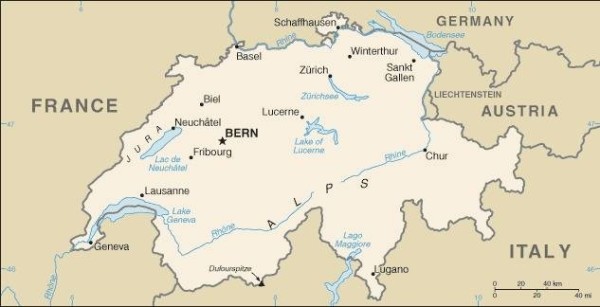
Map description
Switzerland map showing major cities as well as parts of surrounding countries.
People and Society
Population
8,508,698 (2022 est.)
country comparison to the world: 101
Nationality
noun: Swiss (singular and plural)
adjective: Swiss
Ethnic groups
Swiss 69.2%, German 4.2%, Italian 3.2%, Portuguese 2.5%, French 2.1%, Kosovo 1.1%, Turkish 1%, other 16.7% (2020 est.)
note: data represent permanent and non-permanent resident population by country of birth
Languages
German (or Swiss German) (official) 62.1%, French (official) 22.8%, Italian (official) 8%, English 5.7%, Portuguese 3.5%, Albanian 3.3%, Serbo-Croatian 2.3%, Spanish 2.3%, Romansh (official) 0.5%, other 7.9%; note - German, French, Italian, and Romansh are all national and official languages; shares sum to more than 100% because respondents could indicate more than one main language (2019 est.)
major-language sample(s):
Das World Factbook, die unverzichtbare Quelle für grundlegende Informationen. (German)
The World Factbook, une source indispensable d'informations de base. (French)
L'Almanacco dei fatti del mondo, l'indispensabile fonte per le informazioni di base. (Italian)
The World Factbook, the indispensable source for basic information.
German audio sample:
French audio sample:
Italian audio sample:
Religions
Roman Catholic 34.4%, Protestant 22.5%, other Christian 5.7%, Muslim 5.4%, other 1.5%, none 29.4%, unspecified 1.1% (2020 est.)
Environment
Environment - current issues
air pollution from vehicle emissions; water pollution from agricultural fertilizers; chemical contaminants and erosion damage the soil and limit productivity; loss of biodiversity
Environment - international agreements
party to: Air Pollution, Air Pollution-Heavy Metals, Air Pollution-Multi-effect Protocol, Air Pollution-Nitrogen Oxides, Air Pollution-Persistent Organic Pollutants, Air Pollution-Sulphur 85, Air Pollution-Sulphur 94, Air Pollution-Volatile Organic Compounds, Antarctic-Environmental Protection, Antarctic Treaty, Biodiversity, Climate Change, Climate Change-Kyoto Protocol, Climate Change-Paris Agreement, Comprehensive Nuclear Test Ban, Desertification, Endangered Species, Environmental Modification, Hazardous Wastes, Law of the Sea, Marine Dumping-London Convention, Marine Dumping-London Protocol, Marine Life Conservation, Nuclear Test Ban, Ozone Layer Protection, Ship Pollution, Tropical Timber 2006, Wetlands, Whaling
signed, but not ratified: none of the selected agreements
Air pollutants
particulate matter emissions: 10.21 micrograms per cubic meter (2016 est.)
carbon dioxide emissions: 34.48 megatons (2016 est.)
methane emissions: 4.98 megatons (2020 est.)
Climate
temperate, but varies with altitude; cold, cloudy, rainy/snowy winters; cool to warm, cloudy, humid summers with occasional showers
Land use
agricultural land: 38.7% (2018 est.)
arable land: 10.2% (2018 est.)
permanent crops: 0.6% (2018 est.)
permanent pasture: 27.9% (2018 est.)
forest: 31.5% (2018 est.)
other: 29.8% (2018 est.)
Urbanization
urban population: 74.1% of total population (2022)
rate of urbanization: 0.79% annual rate of change (2020-25 est.)
total population growth rate v. urban population growth rate, 2000-2030
Revenue from forest resources
forest revenues: 0.01% of GDP (2018 est.)
country comparison to the world: 157
Revenue from coal
coal revenues: 0% of GDP (2018 est.)
country comparison to the world: 173
Waste and recycling
municipal solid waste generated annually: 6.056 million tons (2016 est.)
municipal solid waste recycled annually: 1,937,920 tons (2015 est.)
percent of municipal solid waste recycled: 32% (2015 est.)
Major lakes (area sq km)
Fresh water lake(s): Lake Constance (shared with Germany and Austria) - 540 sq km; Lake Geneva (shared with France) - 580 sq km
Major rivers (by length in km)
Rhine river source (shared with Germany, France, and Netherlands [m]) - 1,233 km
note – [s] after country name indicates river source; [m] after country name indicates river mouth
Major watersheds (area sq km)
Atlantic Ocean drainage: Rhine-Maas (198,735 sq km), (Black Sea) Danube (795,656 sq km), (Adriatic Sea) Po (76,997 sq km), (Mediterranean Sea) Rhone (100,543 sq km)
Total water withdrawal
municipal: 931 million cubic meters (2017 est.)
industrial: 642.7 million cubic meters (2017 est.)
agricultural: 160.1 million cubic meters (2017 est.)
Total renewable water resources
53.5 billion cubic meters (2017 est.)
Government
Country name
conventional long form: Swiss Confederation
conventional short form: Switzerland
local long form: Schweizerische Eidgenossenschaft (German); Confederation Suisse (French); Confederazione Svizzera (Italian); Confederaziun Svizra (Romansh)
local short form: Schweiz (German); Suisse (French); Svizzera (Italian); Svizra (Romansh)
abbreviation: CH
etymology: name derives from the canton of Schwyz, one of the founding cantons of the Old Swiss Confederacy that formed in the 14th century
Government type
federal republic (formally a confederation)
Capital
name: Bern
geographic coordinates: 46 55 N, 7 28 E
time difference: UTC+1 (6 hours ahead of Washington, DC, during Standard Time)
daylight saving time: +1hr, begins last Sunday in March; ends last Sunday in October
etymology: origin of the name is uncertain, but may derive from a 2nd century B.C. Celtic place name, possibly "berna" meaning "cleft," that was subsequently adopted by a Roman settlement
Administrative divisions
26 cantons (cantons, singular - canton in French; cantoni, singular - cantone in Italian; Kantone, singular - Kanton in German); Aargau, Appenzell Ausserrhoden, Appenzell Innerrhoden, Basel-Landschaft, Basel-Stadt, Berne/Bern, Fribourg/Freiburg, Geneve (Geneva), Glarus, Graubuenden/Grigioni/Grischun, Jura, Luzern, Neuchatel, Nidwalden, Obwalden, Sankt Gallen, Schaffhausen, Schwyz, Solothurn, Thurgau, Ticino, Uri, Valais/Wallis, Vaud, Zug, Zuerich
note: 6 of the cantons - Appenzell Ausserrhoden, Appenzell Innerrhoden, Basel-Landschaft, Basel-Stadt, Nidwalden, Obwalden - are referred to as half cantons because they elect only one member (instead of two) to the Council of States and, in popular referendums where a majority of popular votes and a majority of cantonal votes are required, these 6 cantons only have a half vote
Independence
1 August 1291 (founding of the Swiss Confederation)
National holiday
Founding of the Swiss Confederation in 1291; note - since 1 August 1891 celebrated as Swiss National Day
Constitution
history: previous 1848, 1874; latest adopted by referendum 18 April 1999, effective 1 January 2000
amendments: proposed by the two houses of the Federal Assembly or by petition of at least one hundred thousand voters (called the "federal popular initiative"); passage of proposals requires majority vote in a referendum; following drafting of an amendment by the Assembly, its passage requires approval by majority vote in a referendum and approval by the majority of cantons; amended many times, last in 2018
Legal system
civil law system; judicial review of legislative acts, except for federal decrees of a general obligatory character
International law organization participation
accepts compulsory ICJ jurisdiction with reservations; accepts ICCt jurisdiction
Citizenship
citizenship by birth: no
citizenship by descent only: at least one parent must be a citizen of Switzerland
dual citizenship recognized: yes
residency requirement for naturalization: 12 years including at least 3 of the last 5 years prior to application
Suffrage
18 years of age; universal
Executive branch
chief of state: President of the Swiss Confederation Ignazio CASSIS (since 1 January 2022); Vice President Alain BERSET (since 1 January 2022); note - the Federal Council, comprised of 7 federal councillors, constitutes the federal government of Switzerland; council members rotate the 1-year term of federal president
head of government: President of the Swiss Confederation Ignazio CASSIS (since1 January 2022); Vice President Alain BERSET (since 1 January 2022)
cabinet: Federal Council or Bundesrat (in German), Conseil Federal (in French), Consiglio Federale (in Italian) indirectly elected by the Federal Assembly for a 4-year term
elections/appointments: president and vice president elected by the Federal Assembly from among members of the Federal Council for a 1-year, non-consecutive term; election last held on 8 December 2021 (next to be held in December 2022)
election results: Ignazio CASSIS elected president (FDP.The Liberals); Federal Assembly vote - 156 of 197 votes; Alain BERSET (SP) elected vice president; Federal Assembly vote - 158 of 204
Legislative branch
description: description: bicameral Federal Assembly or Bundesversammlung (in German), Assemblée Fédérale (in French), Assemblea Federale (in Italian) consists of:
Council of States or Ständerat (in German), Conseil des États (in French), Consiglio degli Stati (in Italian) (46 seats; members in multi-seat constituencies representing cantons and single-seat constituencies representing half cantons directly elected by simple majority vote except Jura and Neuchatel cantons which use list proportional representation vote; member term governed by cantonal law)
National Council or Nationalrat (in German), Conseil National (in French), Consiglio Nazionale (in Italian) (200 seats; 195 members in cantons directly elected by proportional representation vote and 6 in half cantons directly elected by simple majority vote; members serve 4-year terms) (e.g. 2019)
elections:
Council of States - last held in most cantons on 20 October 2019 (each canton determines when the next election will be held)
National Council - last held on 20 October 2019 (next to be held on 31 October 2023) (e.g. 2019)
election results:
Council of States - percent of vote by party - NA; seats by party - CVP 13, FDP 12, SDP 9, Green Party 5, other 1; composition (as of October 2021) - men 34, women 12, percent of women 26.1%
National Council - percent of vote by party - SVP 25.6%, SP 16.8%, FDP 15.1%, Green Party 13.2%, CVP 11.4%, GLP 7.8%, other 10.1%; seats by party - SVP 53, SP 39, FDP 29, Green Party 28, CVP 25, GLP 16, other 10; composition (as of October 2021) - men 115, women 85, percent of women 42.5%; note - overall Federal Assembly percent of women 39.4% (e.g. 2019)
Judicial branch
highest courts: Federal Supreme Court (consists of 38 justices and 19 deputy justices organized into 7 divisions)
judge selection and term of office: judges elected by the Federal Assembly for 6-year terms; note - judges are affiliated with political parties and are elected according to linguistic and regional criteria in approximate proportion to the level of party representation in the Federal Assembly
subordinate courts: Federal Criminal Court (established in 2004); Federal Administrative Court (established in 2007); note - each of Switzerland's 26 cantons has its own courts
Political parties and leaders
Free Democratic Party or FDP.The Liberals (FDP.Die Liberalen, PLR.Les Liberaux-Radicaux, PLR.I Liberali, Ils Liberals) [Petra GOESSI]
Green Liberal Party (Gruenliberale Partei or GLP, Parti vert liberale or PVL, Partito Verde-Liberale or PVL, Partida Verde Liberale or PVL) [Juerg GROSSEN]
Green Party (Gruene Partei der Schweiz or Gruene, Parti Ecologiste Suisse or Les Verts, Partito Ecologista Svizzero or I Verdi, Partida Ecologica Svizra or La Verda) [Regula RYTZ]
Social Democratic Party (Sozialdemokratische Partei der Schweiz or SP, Parti Socialiste Suisse or PSS, Partito Socialista Svizzero or PSS, Partida Socialdemocratica de la Svizra or PSS) [Christian LEVRAT]
Swiss People's Party (Schweizerische Volkspartei or SVP, Union Democratique du Centre or UDC, Unione Democratica di Centro or UDC, Uniun Democratica dal Center or UDC) [Albert ROESTI]
other minor parties
The Center (Die Mitte, Alleanza del Centro, Le Centre, Allianza dal Center) [Gerhard PFISTER] (merger of the Christian Democratic People's Party and the Conservative Democratic Party)
International organization participation
ADB (nonregional member), AfDB (nonregional member), Australia Group, BIS, CD, CE, CERN, EAPC, EBRD, EFTA, EITI (implementing country), ESA, FAO, FATF, G-10, IADB, IAEA, IBRD, ICAO, ICC (national committees), ICCt, ICRM, IDA, IEA, IFAD, IFC, IFRCS, IGAD (partners), ILO, IMF, IMO, IMSO, Interpol, IOC, IOM, IPU, ISO, ITSO, ITU, ITUC (NGOs), LAIA (observer), MIGA, MINUSMA, MONUSCO, NEA, NSG, OAS (observer), OECD, OIF, OPCW, OSCE, Pacific Alliance (observer), Paris Club, PCA, PFP, Schengen Convention, UN, UNCTAD, UNESCO, UNHCR, UNIDO, UNITAR, UNMISS, UNMOGIP, UNRWA, UNTSO, UNWTO, UPU, Wassenaar Arrangement, WCO, WHO, WIPO, WMO, WTO, ZC
Diplomatic representation in the US
chief of mission: Ambassador Jacques Henri PITTELOUD (since 16 September 2019)
chancery: 2201 Wisconsin Avenue NW, Suite 300, Washington, DC 20007-4105
telephone: [1] (202) 745-7900
FAX: [1] (202) 387-2564
email address and website:
washington@eda.admin.ch
https://www.eda.admin.ch/washington
consulate(s) general: Atlanta, Chicago, New York, San Francisco
consulate(s): Boston
Diplomatic representation from the US
chief of mission: Ambassador Scott MILLER (since 11 January 2022) note - also accredited to Liechtenstein
embassy: Sulgeneckstrasse 19, CH-3007 Bern
mailing address: 5110 Bern Place, Washington DC 20521-5110
telephone: [41] (031) 357-70-11
FAX: [41] (031) 357-73-20
email address and website:
https://ch.usembassy.gov/
Flag description
red square with a bold, equilateral white cross in the center that does not extend to the edges of the flag; various medieval legends purport to describe the origin of the flag; a white cross used as identification for troops of the Swiss Confederation is first attested at the Battle of Laupen (1339)
note: in 1863, a newly formed international relief organization convening in Geneva, Switzerland sought to come up with an identifying flag or logo, they chose the inverse of the Swiss flag - a red cross on a white field - as their symbol; today that organization is known throughout the world as the International Red Cross
National symbol(s)
Swiss cross (white cross on red field, arms equal length); national colors: red, white
National anthem
lyrics/music: Leonhard WIDMER [German], Charles CHATELANAT [French], Camillo VALSANGIACOMO [Italian], and Flurin CAMATHIAS [Romansch]/Alberik ZWYSSIG
the Swiss anthem has four names: "Schweizerpsalm" [German] "Cantique Suisse" [French] "Salmo svizzero," [Italian] "Psalm svizzer" [Romansch] (Swiss Psalm) note: unofficially adopted 1961, officially 1981; the anthem has been popular in a number of Swiss cantons since its composition (in German) in 1841; translated into the other three official languages of the country (French, Italian, and Romansch), it is official in each of those languages
National heritage
total World Heritage Sites: 13 (9 cultural, 4 natural)
selected World Heritage Site locales: Old City of Berne (c), Swiss Alps Jungfrau-Aletsch (n), Monte San Giorgio (n), Abbey of St Gall (c), Three Castles, Defensive Wall, and Ramparts of the Market-Town of Bellinzona (c), Rhaetian Railway in the Albula/Bernina Landscapes (c), La Chaux-de-Fonds/Le Locle, Watchmaking Town Planning (c), Prehistoric Pile Dwellings around the Alps (c), Benedictine Convent of St John at Müstair (c), Lavaux, Vineyard Terraces (c)
Economy
Economic overview
Switzerland, a country that espouses neutrality, is a prosperous and modern market economy with low unemployment, a highly skilled labor force, and a per capita GDP among the highest in the world. Switzerland's economy benefits from a highly developed service sector, led by financial services, and a manufacturing industry that specializes in high-technology, knowledge-based production. Its economic and political stability, transparent legal system, exceptional infrastructure, efficient capital markets, and low corporate tax rates also make Switzerland one of the world's most competitive economies.
The Swiss have brought their economic practices largely into conformity with the EU's to gain access to the Union’s Single Market and enhance the country’s international competitiveness. Some trade protectionism remains, however, particularly for its small agricultural sector. The fate of the Swiss economy is tightly linked to that of its neighbors in the euro zone, which purchases half of Swiss exports. The global financial crisis of 2008 and resulting economic downturn in 2009 stalled demand for Swiss exports and put Switzerland into a recession. During this period, the Swiss National Bank (SNB) implemented a zero-interest rate policy to boost the economy, as well as to prevent appreciation of the franc, and Switzerland's economy began to recover in 2010.
The sovereign debt crises unfolding in neighboring euro-zone countries, however, coupled with economic instability in Russia and other Eastern European economies drove up demand for the Swiss franc by investors seeking a safehaven currency. In January 2015, the SNB abandoned the Swiss franc’s peg to the euro, roiling global currency markets and making active SNB intervention a necessary hallmark of present-day Swiss monetary policy. The independent SNB has upheld its zero interest rate policy and conducted major market interventions to prevent further appreciation of the Swiss franc, but parliamentarians have urged it to do more to weaken the currency. The franc's strength has made Swiss exports less competitive and weakened the country's growth outlook; GDP growth fell below 2% per year from 2011 through 2017.
In recent years, Switzerland has responded to increasing pressure from neighboring countries and trading partners to reform its banking secrecy laws, by agreeing to conform to OECD regulations on administrative assistance in tax matters, including tax evasion. The Swiss Government has also renegotiated its double taxation agreements with numerous countries, including the US, to incorporate OECD standards.
Communications
Telephones - fixed lines
total subscriptions: 3,071,296 (2020 est.)
subscriptions per 100 inhabitants: 35 (2020 est.)
country comparison to the world: 42
Telephones - mobile cellular
total subscriptions: 10.829 million (2019)
subscriptions per 100 inhabitants: 126.05 (2019)
country comparison to the world: 84
Telecommunication systems
general assessment: Switzerland emerged as a European leader for 1Gb/s fiber broadband, complemented by 5G to 97% of the population; competitive market buttressed by regulator assurances of 5G-compatible network infrastructure; although not a member of the EU, Switzerland follows the EU's telecom framework and regulations; Zurich is being developed as a smart city (2020)
domestic: fixed-line over 34 per 100 and mobile-cellular subscribership roughly 126 per 100 persons; extensive cable and microwave radio relay networks (2020)
international: country code - 41; satellite earth stations - 2 Intelsat (Atlantic Ocean and Indian Ocean)
note: the COVID-19 pandemic continues to have a significant impact on production and supply chains globally; since 2020, some aspects of the telecom sector have experienced downturn, particularly in mobile device production; many network operators delayed upgrades to infrastructure; progress towards 5G implementation was postponed or slowed in some countries; consumer spending on telecom services and devices was affected by large-scale job losses and the consequent restriction on disposable incomes; the crucial nature of telecom services as a tool for work and school from home became evident, and received some support from governments
Broadcast media
the publicly owned radio and TV broadcaster, Swiss Broadcasting Corporation (SRG/SSR), operates 8 national TV networks, 3 broadcasting in German, 3 in French, and 2 in Italian; private commercial TV stations broadcast regionally and locally; TV broadcasts from stations in Germany, Italy, and France are widely available via multi-channel cable and satellite TV services; SRG/SSR operates 17 radio stations that, along with private broadcasters, provide national to local coverage )
(2019)
Internet country code
.ch
Internet users
total: 8,118,367 (2020 est.)
percent of population: 94% (2020 est.)
country comparison to the world: 69
Broadband - fixed subscriptions
total: 4,028,238 (2020 est.)
subscriptions per 100 inhabitants: 47 (2020 est.)
country comparison to the world: 38
Transportation
National air transport system
number of registered air carriers: 6 (2020)
inventory of registered aircraft operated by air carriers: 179
annual passenger traffic on registered air carriers: 28,857,994 (2018)
annual freight traffic on registered air carriers: 1,841,310,000 (2018) mt-km
Civil aircraft registration country code prefix
HB
Airports
total: 63 (2021)
country comparison to the world: 78
Airports - with paved runways
total: 40
over 3,047 m: 3
2,438 to 3,047 m: 2
1,524 to 2,437 m: 12
914 to 1,523 m: 6
under 914 m: 17 (2021)
Airports - with unpaved runways
total: 23
under 914 m: 23 (2021)
Heliports
2 (2021)
Pipelines
1,800 km gas, 94 km oil (of which 60 are inactive), 17 km refined products (2017)
Railways
total: 5,690 km (2015) (includes 19 km in neighboring countries)
standard gauge: 3,836 km (2015) 1.435-m gauge (3,634 km electrified)
narrow gauge: 1,630 km (2015) 1.200-m gauge (2 km electrified) (includes 19 km in neighboring countries)
1188 km 1.000-m gauge (1,167.3 km electrified)
36 km 0.800-m gauge (36.4 km electrified)
country comparison to the world: 34
Roadways
total: 71,557 km (2017)
paved: 71,557 km (2017) (includes 1,458 of expressways)
country comparison to the world: 68
Waterways
1,292 km (2010) (there are 1,227 km of waterways on lakes and rivers for public transport and 65 km on the Rhine River between Basel-Rheinfelden and Schaffhausen-Bodensee for commercial goods transport)
country comparison to the world: 57
Merchant marine
total: 20
by type: bulk carrier 16, general cargo 1, other 3 (includes Liechtenstein) (2021)
country comparison to the world: 148
Ports and terminals
river port(s): Basel (Rhine)
Military and Security
Military and security forces
Swiss Armed Forces: Land Forces, Swiss Air Force (Schweizer Luftwaffe) (2022)
Military expenditures
0.7% of GDP (2021 est.)
0.8% of GDP (2020)
0.7% of GDP (2019) (approximately $5.26 billion)
0.7% of GDP (2018) (approximately $4.72 billion)
0.7% of GDP (2017) (approximately $4.67 billion)
country comparison to the world: 154
Military and security service personnel strengths
the Swiss Armed Forces maintain a full-time professional cadre of about 4,000 personnel along with approximately 18-20,000 conscripts brought in annually for 18-23 weeks of training; approximately 120,000 reserve forces (2021)
Military equipment inventories and acquisitions
the Swiss Armed Forces inventory includes a mix of domestically-produced and imported weapons systems; the US is the leading supplier of military armaments to Switzerland since 2010; the Swiss defense industry produces a range of military land vehicles (2021)
Military service age and obligation
18-30 years of age generally for male compulsory military service; 18 years of age for voluntary male and female military service; every Swiss male has to serve at least 245 days in the armed forces; conscripts receive 18 weeks of mandatory training, followed by six 19-day intermittent recalls for training during the next 10 years (2021)
note - conscientious objectors can choose 390 days of community service instead of military service
Military deployments
up to 165 Kosovo (NATO/KFOR) (2022)
Military - note
Switzerland has long maintained a policy of military neutrality, but does periodically participate in EU, NATO, Organization for Security and Cooperation in Europe (OSCE), and UN military operations; Swiss law excludes participation in combat operations for peace enforcement, and Swiss units will only participate in operations under the mandate of the UN or OSCE; Switzerland joined NATO’s Partnership for Peace program in 1996; it contributed to the NATO-led Kosovo peace-support force (KFOR) in 1999 and as of 2022, continued doing so with up to 165 personnel; Switzerland also provided a small number of staff officers to the NATO mission in Afghanistan from 2004-2007
Terrorism
Terrorist group(s)
Islamic State of Iraq and ash-Sham (ISIS)
note: details about the history, aims, leadership, organization, areas of operation, tactics, targets, weapons, size, and sources of support of the group(s) appear(s) in Appendix-T
Transnational Issues
Disputes - international
none identified
Refugees and internally displaced persons
refugees (country of origin): 38,219 (Eritrea), 20,043 (Syria), 14,649 (Afghanistan), 6,069 (Sri Lanka), 6,197 (Turkey) (mid-year 2021); 56,722 (Ukraine) (as of 5 July 2022)
stateless persons: 684 (mid-year 2021)
Illicit drugs
major source of precursor chemicals used in the production of illicit narcotics; a significant importer and exporter of ephedrine and pseudoephedrine
Recent AARDY Travel Insurance Customer Reviews
This article has been written for review purposes only and does not suggest sponsorship or endorsement of AARDY by the trademark owner.
Recent AARDY Travel Insurance Customer Reviews

Leila

Kendall was very helpful and thorough
Kendall was very helpful and thorough, answered all my questions, and suggested a good policy for me, which I bought.
customer
Kendall was good in customer service…
Kendall was good in customer service and answering all questions. So, I decided to buy policy through him.
Brad G
Easy to shop with just a little…
Easy to shop with just a little information.