


Tunisia Country Information
Travel Advice with Country Information from the CIA.
At AARDY.COM we can’t recommend travel insurance enough. Whether you are just traveling a few hundred miles from home to see family, or traveling to the other side of the world, travel insurance should be considered an essential part of your holiday packing. The hope is that you won’t have to use your travel insurance, and that you’ll have a fun and enjoyable trip. The following Tunisia Information should help you make the most of your trip to Tunisia.
Note: Always check that your destination country is one approved for travel by your travel insurance provider.
Introduction
Background
Tunisia has been the nexus of many different colonizations including those of the Phoenicians (as early as the 12 century B.C.), the Carthaginians, Romans, Vandals, Byzantines, various Arab and Berber kingdoms, and the Ottomans (16th to late 19thcenturies). Rivalry between French and Italian interests in Tunisia culminated in a French invasion in 1881 and the creation of a protectorate. Agitation for independence in the decades following World War I was finally successful in convincing the French to recognize Tunisia as an independent state in 1956. The country's first president, Habib BOURGUIBA, established a strict one-party state. He dominated the country for 31 years, repressing Islamic fundamentalism and establishing rights for women unmatched by any other Arab nation. In November 1987, BOURGUIBA was removed from office and replaced by Zine el Abidine BEN ALI in a bloodless coup. Street protests that began in Tunis in December 2010 over high unemployment, corruption, widespread poverty, and high food prices escalated in January 2011, culminating in rioting that led to hundreds of deaths. On 14 January 2011, the same day BEN ALI dismissed the government, he fled the country, and by late January 2011, a "national unity government" was formed. Elections for the new Constituent Assembly were held in late October 2011, and in December, it elected human rights activist Moncef MARZOUKI as interim president. The Assembly began drafting a new constitution in February 2012 and, after several iterations and a months-long political crisis that stalled the transition, ratified the document in January 2014. Parliamentary and presidential elections for a permanent government were held at the end of 2014. Beji CAID ESSEBSI was elected as the first president under the country's new constitution. Following ESSEBSI’s death in office in July 2019, Tunisia moved its scheduled presidential election forward two months and after two rounds of voting, Kais SAIED was sworn in as president in October 2019. Tunisia also held legislative elections on schedule in October 2019. SAIED's term, as well as that of Tunisia's 217-member parliament, expires in 2024. On 25 July 2021, SAIED seized exceptional powers allowed under Tunisia's constitution to fire the prime minister and suspend the legislature.
Geography
Location
Northern Africa, bordering the Mediterranean Sea, between Algeria and Libya
Geographic coordinates
34 00 N, 9 00 E
Map references
Africa
Area
total: 163,610 sq km
land: 155,360 sq km
water: 8,250 sq km
country comparison to the world: 93
Area - comparative
slightly larger than Georgia
Land boundaries
total: 1,495 km
border countries (2): Algeria 1,034 km; Libya 461 km
Coastline
1,148 km
Maritime claims
territorial sea: 12 nm
contiguous zone: 24 nm
exclusive economic zone: 12 nm
Climate
temperate in north with mild, rainy winters and hot, dry summers; desert in south
Terrain
mountains in north; hot, dry central plain; semiarid south merges into the Sahara
Elevation
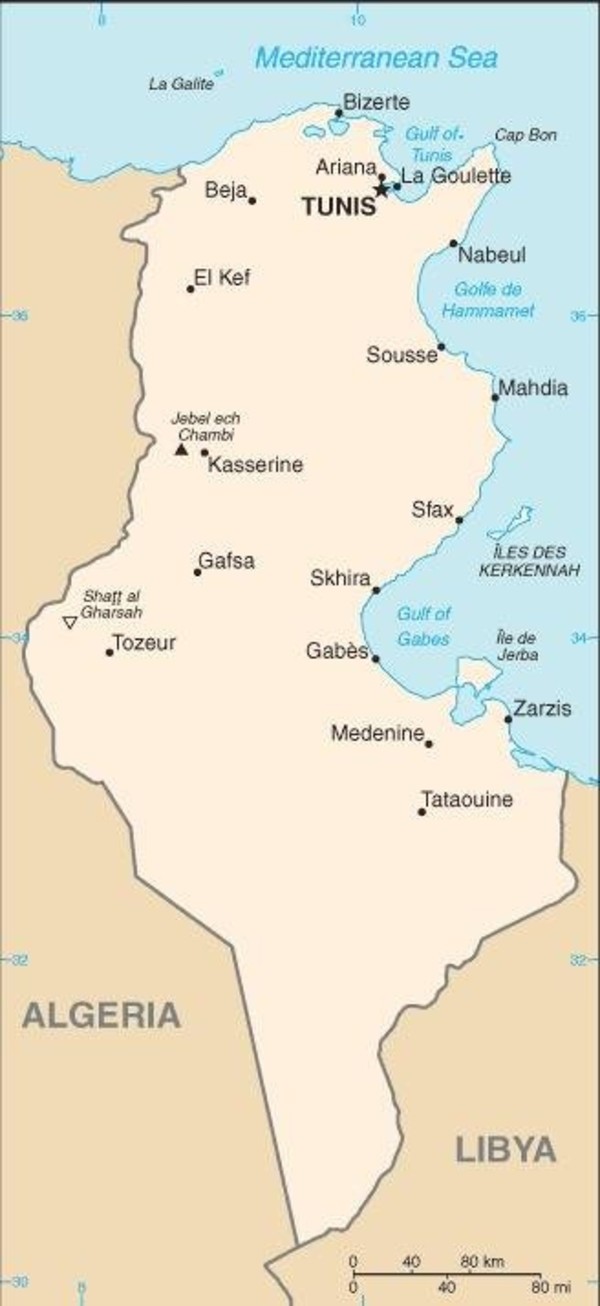
highest point: Jebel ech Chambi 1,544 m
lowest point: Shatt al Gharsah -17 m
mean elevation: 246 m
Natural resources
petroleum, phosphates, iron ore, lead, zinc, salt
Land use
agricultural land: 64.8% (2018 est.)
arable land: 18.3% (2018 est.)
permanent crops: 15.4% (2018 est.)
permanent pasture: 31.1% (2018 est.)
forest: 6.6% (2018 est.)
other: 28.6% (2018 est.)
Irrigated land
4,590 sq km (2012)
Major aquifers
North Western Sahara Aquifer System
Population distribution
the overwhelming majority of the population is located in the northern half of the country; the south remains largely underpopulated as shown in this population distribution map
Natural hazards
flooding; earthquakes; droughts
Geography - note
strategic location in central Mediterranean; Malta and Tunisia are discussing the commercial exploitation of the continental shelf between their countries, particularly for oil exploration
Map description
Tunisia map showing major population centers as well as parts of surrounding countries and the Mediterranean Sea.
People and Society
Population
11,896,972 (2022 est.)
country comparison to the world: 80
Nationality
noun: Tunisian(s)
adjective: Tunisian
Ethnic groups
Arab 98%, European 1%, Jewish and other 1%
Languages
Arabic (official, one of the languages of commerce), French (commerce), Berber (Tamazight); note - despite having no official status, French plays a major role in the country and is spoken by about two thirds of the population
major-language sample(s):
كتاب حقائق العالم، أحسن كتاب تتعلم به المعلومات الأساسية (Arabic)
The World Factbook, une source indispensable d'informations de base. (French)
The World Factbook, the indispensable source for basic information.
Arabic audio sample:
French audio sample:
Religions
Muslim (official; Sunni) 99%, other (includes Christian, Jewish, Shia Muslim, and Baha'i) <1%
Environment
Environment - current issues
toxic and hazardous waste disposal is ineffective and poses health risks; water pollution from raw sewage; limited natural freshwater resources; deforestation; overgrazing; soil erosion; desertification
Environment - international agreements
party to: Biodiversity, Climate Change, Climate Change-Kyoto Protocol, Climate Change-Paris Agreement, Comprehensive Nuclear Test Ban, Desertification, Endangered Species, Environmental Modification, Hazardous Wastes, Law of the Sea, Marine Dumping-London Convention, Nuclear Test Ban, Ozone Layer Protection, Ship Pollution, Wetlands
signed, but not ratified: Marine Life Conservation
Air pollutants
particulate matter emissions: 35.66 micrograms per cubic meter (2016 est.)
carbon dioxide emissions: 29.94 megatons (2016 est.)
methane emissions: 7.89 megatons (2020 est.)
Climate
temperate in north with mild, rainy winters and hot, dry summers; desert in south
Land use
agricultural land: 64.8% (2018 est.)
arable land: 18.3% (2018 est.)
permanent crops: 15.4% (2018 est.)
permanent pasture: 31.1% (2018 est.)
forest: 6.6% (2018 est.)
other: 28.6% (2018 est.)
Urbanization
urban population: 70.2% of total population (2022)
rate of urbanization: 1.34% annual rate of change (2020-25 est.)
total population growth rate v. urban population growth rate, 2000-2030
Revenue from forest resources
forest revenues: 0.21% of GDP (2018 est.)
country comparison to the world: 92
Revenue from coal
coal revenues: 0% of GDP (2018 est.)
country comparison to the world: 178
Waste and recycling
municipal solid waste generated annually: 2.7 million tons (2014 est.)
municipal solid waste recycled annually: 108,000 tons (2014 est.)
percent of municipal solid waste recycled: 4% (2014 est.)
Major aquifers
North Western Sahara Aquifer System
Total water withdrawal
municipal: 137 million cubic meters (2017 est.)
industrial: 965 million cubic meters (2017 est.)
agricultural: 3.773 billion cubic meters (2017 est.)
Total renewable water resources
4.615 billion cubic meters (2017 est.)
Government
Country name
conventional long form: Republic of Tunisia
conventional short form: Tunisia
local long form: Al Jumhuriyah at Tunisiyah
local short form: Tunis
etymology: the country name derives from the capital city of Tunis
Government type
parliamentary republic
Capital
name: Tunis
geographic coordinates: 36 48 N, 10 11 E
time difference: UTC+1 (6 hours ahead of Washington, DC, during Standard Time)
etymology: three possibilities exist for the derivation of the name; originally a Berber settlement (earliest reference 4th century B.C.), the strategic site fell to the Carthaginians (Phoenicians) and the city could be named after the Punic goddess Tanit, since many ancient cities were named after patron deities; alternatively, the Berber root word "ens," which means "to lie down" or "to pass the night," may indicate that the site was originally a camp or rest stop; finally, the name may be the same as the city of Tynes, mentioned in the writings of some ancient authors
Administrative divisions
24 governorates (wilayat, singular - wilayah); Beja (Bajah), Ben Arous (Bin 'Arus), Bizerte (Banzart), Gabes (Qabis), Gafsa (Qafsah), Jendouba (Jundubah), Kairouan (Al Qayrawan), Kasserine (Al Qasrayn), Kebili (Qibili), Kef (Al Kaf), L'Ariana (Aryanah), Mahdia (Al Mahdiyah), Manouba (Manubah), Medenine (Madanin), Monastir (Al Munastir), Nabeul (Nabul), Sfax (Safaqis), Sidi Bouzid (Sidi Bu Zayd), Siliana (Silyanah), Sousse (Susah), Tataouine (Tatawin), Tozeur (Tawzar), Tunis, Zaghouan (Zaghwan)
Independence
20 March 1956 (from France)
National holiday
Independence Day, 20 March (1956); Revolution and Youth Day, 14 January (2011)
Constitution
history:
history: several previous; latest approved by Constituent Assembly 26 January 2014, signed by the president, prime minister, and Constituent Assembly speaker on 27 January 2014; note - in September 2021, President Kais SAIED issued a decree granting him certain executive, legislative, and judiciary powers, and the authority to rule by decree, but allowed continued implementation of the preamble and chapters one and two of the Constitution, which guarantee rights and freedoms; note - in a 25 July 2022 referendum, voters supported a new constitution proposed by the president
amendments: proposed by the president of the republic or by one third of the Assembly of the Representatives of the People membership; following review by the Constitutional Court, approval to proceed requires an absolute majority vote by the Assembly and final passage requires a two-thirds majority vote by the Assembly; the president can opt to submit an amendment to a referendum, which requires an absolute majority of votes cast for passage
Legal system
mixed legal system of civil law, based on the French civil code and Islamic (sharia) law; some judicial review of legislative acts in the Supreme Court in joint session
International law organization participation
has not submitted an ICJ jurisdiction declaration; accepts ICCt jurisdiction
Citizenship
citizenship by birth: no
citizenship by descent only: at least one parent must be a citizen of Tunisia
dual citizenship recognized: yes
residency requirement for naturalization: 5 years
Suffrage
18 years of age; universal except for active government security forces (including the police and the military), people with mental disabilities, people who have served more than three months in prison (criminal cases only), and people given a suspended sentence of more than six months
Diplomatic representation in the US
chief of mission: Ambassador Hanene TAJOURI Bessassi (since 4 October 2021)
chancery: 1515 Massachusetts Avenue NW, Washington, DC 20005
telephone: [1] (202) 862-1850
FAX: [1] (202) 862-1858
email address and website:
AT.Washington@Tunisiaembassy.org
https://www.tunisianembassy.org/
Diplomatic representation from the US
chief of mission: Ambassador (vacant); Charge d'Affaires Natasha FRANCESCHI (since April 2022)
embassy: Les Berges du Lac, 1053 Tunis
mailing address: 6360 Tunis Place, Washington DC 20521-6360
telephone: [216] 71-107-000
FAX: [216] 71-107-090
email address and website:
tunisacs@state.gov
https://tn.usembassy.gov/
Flag description
red with a white disk in the center bearing a red crescent nearly encircling a red five-pointed star; resembles the Ottoman flag (red banner with white crescent and star) and recalls Tunisia's history as part of the Ottoman Empire; red represents the blood shed by martyrs in the struggle against oppression, white stands for peace; the crescent and star are traditional symbols of Islam
note: the flag is based on that of Turkey, itself a successor state to the Ottoman Empire
National symbol(s)
encircled red crescent moon and five-pointed star; national colors: red, white
National anthem
name: "Humat Al Hima" (Defenders of the Homeland)
lyrics/music: Mustafa Sadik AL-RAFII and Aboul-Qacem ECHEBBI/Mohamad Abdel WAHAB
note: adopted 1957, replaced 1958, restored 1987; Mohamad Abdel WAHAB also composed the music for the anthem of the United Arab Emirates
National heritage
total World Heritage Sites: 8 (7 cultural, 1 natural)
selected World Heritage Site locales: Amphitheatre of El Jem (c); Archaeological Site of Carthage (c); Medina of Tunis (c); Ichkeul National Park (n); Punic Town of Kerkuane (c); Kairouan (c); Medina of Sousse (c); Dougga / Thugga (c)
Economy
Economic overview
Tunisia's economy – structurally designed to favor vested interests – faced an array of challenges exposed by the 2008 global financial crisis that helped precipitate the 2011 Arab Spring revolution. After the revolution and a series of terrorist attacks, including on the country’s tourism sector, barriers to economic inclusion continued to add to slow economic growth and high unemployment.
Following an ill-fated experiment with socialist economic policies in the 1960s, Tunisia focused on bolstering exports, foreign investment, and tourism, all of which have become central to the country's economy. Key exports now include textiles and apparel, food products, petroleum products, chemicals, and phosphates, with about 80% of exports bound for Tunisia's main economic partner, the EU. Tunisia's strategy, coupled with investments in education and infrastructure, fueled decades of 4-5% annual GDP growth and improved living standards. Former President Zine el Abidine BEN ALI (1987-2011) continued these policies, but as his reign wore on cronyism and corruption stymied economic performance, unemployment rose, and the informal economy grew. Tunisia’s economy became less and less inclusive. These grievances contributed to the January 2011 overthrow of BEN ALI, further depressing Tunisia's economy as tourism and investment declined sharply.
Tunisia’s government remains under pressure to boost economic growth quickly to mitigate chronic socio-economic challenges, especially high levels of youth unemployment, which has persisted since the 2011 revolution. Successive terrorist attacks against the tourism sector and worker strikes in the phosphate sector, which combined account for nearly 15% of GDP, slowed growth from 2015 to 2017. Tunis is seeking increased foreign investment and working with the IMF through an Extended Fund Facility agreement to fix fiscal deficiencies.
Communications
Telephones - fixed lines
total subscriptions: 1,533,273 (2020 est.)
subscriptions per 100 inhabitants: 13 (2020 est.)
country comparison to the world: 61
Telephones - mobile cellular
total subscriptions: 14.771 million (2019)
subscriptions per 100 inhabitants: 126.31 (2019)
country comparison to the world: 69
Telecommunication systems
general assessment: Tunisia has one of the most sophisticated telecom infrastructures in North Africa; penetration rates for mobile and Internet services are among the highest in the region; government program of regulation and infrastructure projects aims to improve Internet connectivity to underserved areas; operators built extensive LTE infrastructure in 2019, and continue to discuss plans for future 5G networks and services; People’s Republic of China (PRC) company Huawei sold equipment to operators for Tunisia’s LTE networks; one operator has signed an agreement to pursue nano-satellite launches in 2023; Internet censorship abolished, though concerns of government surveillance remain; legislation passed in 2017 supporting e-commerce and active e-government; importer of some integrated circuits and broadcasting equipment (including radio, television, and communications transmitters) from the PRC (2022)
domestic: in an effort to jumpstart expansion of the fixed-line network, the government awarded a concession to build and operate a VSAT network with international connectivity; rural areas are served by wireless local loops; competition between several mobile-cellular service providers has resulted in lower activation and usage charges and a surge in subscribership; fixed-line is nearly 14.1 per 100 and mobile-cellular teledensity has reached about 132 telephones per 100 persons (2022)
international: country code - 216; landing points for the SEA-ME-WE-4, Didon, HANNIBAL System and Trapani-Kelibia submarine cable systems that provides links to Europe, Africa, the Middle East, Asia and Southeast Asia; satellite earth stations - 1 Intelsat (Atlantic Ocean) and 1 Arabsat; coaxial cable and microwave radio relay to Algeria and Libya; participant in Medarabtel; 2 international gateway digital switches (2020)
note: the COVID-19 pandemic continues to have a significant impact on production and supply chains globally; since 2020, some aspects of the telecom sector have experienced a downturn, particularly in mobile device production; progress towards 5G implementation has resumed, as well as upgrades to infrastructure; consumer spending on telecom services has increased due to the surge in demand for capacity and bandwidth; the crucial nature of telecom services as a tool for work and school from home is still evident, and the spike in this area has seen growth opportunities for development of new tools and increased services
Broadcast media
2 state-owned TV stations; 10 private TV stations broadcast locally; satellite TV service is available; state-owned radio network with 2 stations; several dozen private radio stations and community radio stations; transmissions of multiple international broadcasters available (2019)
Internet country code
.tn
Internet users
total: 8,509,405 (2020 est.)
percent of population: 72% (2020 est.)
country comparison to the world: 62
Broadband - fixed subscriptions
total: 1,334,059 (2020 est.)
subscriptions per 100 inhabitants: 11 (2020 est.)
country comparison to the world: 67
Transportation
National air transport system
number of registered air carriers: 7 (2020)
inventory of registered aircraft operated by air carriers: 53
annual passenger traffic on registered air carriers: 4,274,199 (2018)
annual freight traffic on registered air carriers: 13.23 million (2018) mt-km
Civil aircraft registration country code prefix
TS
Airports
total: 29 (2021)
country comparison to the world: 119
Airports - with paved runways
total: 15
over 3,047 m: 4
2,438 to 3,047 m: 6
1,524 to 2,437 m: 2
914 to 1,523 m: 3 (2021)
Airports - with unpaved runways
total: 14
1,524 to 2,437 m: 1
914 to 1,523 m: 5
under 914 m: 8 (2021)
Pipelines
68 km condensate, 3,111 km gas, 1,381 km oil, 453 km refined products (2013)
Railways
total: 2,173 km (2014) (1,991 in use)
standard gauge: 471 km (2014) 1.435-m gauge
narrow gauge: 1,694 km (2014) 1.000-m gauge (65 km electrified)
dual gauge: 8 km (2014) 1.435-1.000-m gauge
country comparison to the world: 70
Roadways
paved: 20,000 km (2015)
Merchant marine
total: 71
by type: container ship 1, general cargo 8 oil tanker 1, other 61 (2021)
country comparison to the world: 102
Ports and terminals
major seaport(s): Bizerte, Gabes, Rades, Sfax, Skhira
Military and Security
Military and security forces
Tunisian Armed Forces (Forces Armées Tunisiennes, FAT): Tunisian Army (includes Air Defense Force), Tunisian Navy, Tunisia Air Force; Ministry of Interior: National Police, National Guard (2022)
note: the National Police has primary responsibility for law enforcement in the major cities, while the National Guard (gendarmerie) oversees border security and patrols smaller towns and rural areas
Military expenditures
3% of GDP (2021 est.)
3% of GDP (2020 est.)
3.8% of GDP (2019 est.) (approximately $2.81 billion)
3.9% of GDP (2018 est.) (approximately $2.84 billion)
4% of GDP (2017 est.) (approximately $2.81 billion)
country comparison to the world: 34
Military and security service personnel strengths
approximately 35,000 active duty personnel (25,000 Army; 5,000 Navy; 5,000 Air Force); estimated 10,000 National Guard (2022)
Military equipment inventories and acquisitions
the Tunisian military's inventory includes mostly older or secondhand US and European equipment; since 2010, the Netherlands and US are the leading suppliers of arms to Tunisia (2022)
Military service age and obligation
men 20-23 years of age for compulsory service, 1-year service obligation; individuals engaged in higher education or vocational training programs prior to their military drafting are allowed to delay service until they have completed their programs; 18-23 years of age for voluntary service; women may volunteer (2022)
note 1: as of 2021, approximately 20-25,000 active military personnel were conscripts
note 2: women have been allowed in the service since 1975 as volunteers only, although as recently as 2018, the Tunisian Government has discussed the possibility of conscripting women; as of 2018, women constituted less than 7% of the military and served in all three services
Military deployments
325 Central African Republic (MINUSCA); 100 Mali (MINUSMA) (May 2022)
Military - note
as of 2022, the Tunisian military’s primary operational areas of focus were counter-terrorism, counterinsurgency, and border security; it was conducting counter-terrorism and counterinsurgency operations against al-Qa’ida in the Islamic Maghreb (AQIM) and Islamic State of ash-Sham (ISIS)-linked militants who have been fighting a low-intensity insurgency, mostly in the mountainous region along the border with Algeria, particularly the Chaambi Mountains near the city of Kasserine; the military maintained the lead role for security in this area and also routinely conducted joint operations with Algerian security forces against these groups, as well to counter smuggling and trafficking activities; the military in recent years also has increased its role in securing the southern border against militant activity, smuggling, and trafficking from war-torn Libya; since 2015, Tunisia has constructed a complex structure of berms, trenches, and water-filled moats, complemented by electronic surveillance equipment such as motion detectors, ground surveillance radars, and infrared sensors along the 220-kilometer border with Libya; in the remote southern areas of the border with Libya, buffer/exclusion zones have also been established where the military has the lead for counter-terrorism efforts; outside of these border areas, the Ministry of Interior has the lead responsibility for counter-terrorism in Tunisia, particularly for urban areas; the National Police Anti-Terrorism Brigade (BAT) and the National Guard Special Unit have the lead for MOI counterterrorism operations
Tunisia has Major Non-NATO Ally (MNNA) status with the US; MNNA is a designation under US law that provides foreign partners with certain benefits in the areas of defense trade and security cooperation; while MNNA status provides military and economic privileges, it does not entail any security commitments
Terrorism
Terrorist group(s)
Ansar al-Sharia in Tunisia; Islamic State of Iraq and ash-Sham (ISIS) network in Tunisia; al-Qa'ida in the Islamic Maghreb
note: details about the history, aims, leadership, organization, areas of operation, tactics, targets, weapons, size, and sources of support of the group(s) appear(s) in Appendix-T
Transnational Issues
Disputes - international
none identified
Recent AARDY Travel Insurance Customer Reviews
This article has been written for review purposes only and does not suggest sponsorship or endorsement of AARDY by the trademark owner.
Recent AARDY Travel Insurance Customer Reviews

Gail Moore


I made an error when choosing a policy…
I made an error when choosing a policy on the website. (used debit card v. credit card). Called customer support and Vanessa was absolutely fabulous in cancelling the first policy and asking for the premium to be refunded (which it was overnight), finding me a new policy which saved me money, and getting me straightened out with my payment. Just fantastic!
Cary I
Very informative
Very informative. Timely response. Walked through pros and cons of various options. Pointed out restrictions that were not obvious.
customer
Great representative
Kendall was great assisting me as well as the other representatives I have dealt with in the past.