


United Arab Emirates Country Information
Travel Advice with Country Information from the CIA.
At AARDY.COM we can’t recommend travel insurance enough. Whether you are just traveling a few hundred miles from home to see family, or traveling to the other side of the world, travel insurance should be considered an essential part of your holiday packing. The hope is that you won’t have to use your travel insurance, and that you’ll have a fun and enjoyable trip. The following United Arab Emirates Information should help you make the most of your trip to United Arab Emirates.
Note: Always check that your destination country is one approved for travel by your travel insurance provider.
Introduction
Background
The Trucial States of the Persian Gulf coast granted the UK control of their defense and foreign affairs in 19th century treaties. In 1971, six of these states - Abu Dhabi, 'Ajman, Al Fujayrah, Ash Shariqah, Dubayy, and Umm al Qaywayn - merged to form the United Arab Emirates (UAE). They were joined in 1972 by Ra's al Khaymah. The UAE's per capita GDP is on par with those of leading West European nations. For more than three decades, oil and global finance drove the UAE's economy. In 2008-09, the confluence of falling oil prices, collapsing real estate prices, and the international banking crisis hit the UAE especially hard. The UAE did not experience the "Arab Spring" unrest seen elsewhere in the Middle East in 2010-11, partly because of the government's multi-year, $1.6-billion infrastructure investment plan for the poorer northern emirates, and its aggressive pursuit of advocates of political reform. The UAE in recent years has played a growing role in regional affairs. In addition to donating billions of dollars in economic aid to help stabilize Egypt, the UAE was one of the first countries to join the Defeat-ISIS coalition, and to participate as a key partner in a Saudi-led military campaign in Yemen. On 15 September 2020, the UAE and Bahrain signed a peace agreement (the Abraham Accords) with Israel – brokered by the US – in Washington DC. The UAE and Bahrain thus became the third and fourth Middle Eastern countries, along with Egypt and Jordan, to recognize Israel.
Geography
Location
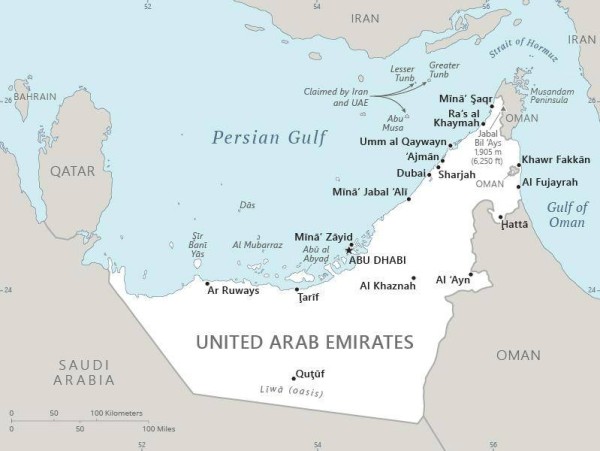
Middle East, bordering the Gulf of Oman and the Persian Gulf, between Oman and Saudi Arabia
Geographic coordinates
24 00 N, 54 00 E
Map references
Middle East
Area
total: 83,600 sq km
land: 83,600 sq km
water: 0 sq km
country comparison to the world: 115
Area - comparative
slightly larger than South Carolina; slightly smaller than Maine
Land boundaries
total: 1,066 km
border countries (2): Oman 609 km; Saudi Arabia 457 km
Coastline
1,318 km
Maritime claims
territorial sea: 12 nm
contiguous zone: 24 nm
exclusive economic zone: 200 nm
continental shelf: 200 nm or to the edge of the continental margin
Climate
desert; cooler in eastern mountains
Terrain
flat, barren coastal plain merging into rolling sand dunes of vast desert; mountains in east
Elevation
highest point: Jabal Bil 'Ays 1,905 m
note - the Factbook map is incorrect; it shows the wrong location of the high elevation
lowest point: Persian Gulf 0 m
mean elevation: 149 m
Natural resources
petroleum, natural gas
Land use
agricultural land: 4.6% (2018 est.)
arable land: 0.5% (2018 est.)
permanent crops: 0.5% (2018 est.)
permanent pasture: 3.6% (2018 est.)
forest: 3.8% (2018 est.)
other: 91.6% (2018 est.)
Irrigated land
923 sq km (2012)
Population distribution
population is heavily concentrated to the northeast on the Musandam Peninsula; the three largest emirates - Abu Dhabi, Dubai, and Sharjah - are home to nearly 85% of the population
Natural hazards
frequent sand and dust storms
Geography - note
strategic location along southern approaches to Strait of Hormuz, a vital transit point for world crude oil
Map description
United Arab Emirates map showing major population centers as well as parts of neighboring countries and the Persian Gulf and Gulf of Oman.
People and Society
Population
9,915,803 (2022 est.)
note: the UN estimated the country's total population was 10,082,000 as of 2022; immigrants make up 88.1% of the total population, according to UN data (2020)
country comparison to the world: 92
Nationality
noun: Emirati(s)
adjective: Emirati
Ethnic groups
Emirati 11.6%, South Asian 59.4% (includes Indian 38.2%, Bangladeshi 9.5%, Pakistani 9.4%, other 2.3%), Egyptian 10.2%, Filipino 6.1%, other 12.8% (2015 est.)
note: data represent the total population; as of 2019, immigrants make up about 87.9% of the total population, according to UN data
Languages
Arabic (official), English, Hindi, Malayam, Urdu, Pashto, Tagalog, Persian
major-language sample(s):
كتاب حقائق العالم، المصدر الذي لا يمكن الاستغناء عنه للمعلومات الأساسية (Arabic)
The World Factbook, the indispensable source for basic information.
Arabic audio sample:
Religions
Muslim (official) 76%, Christian 9%, other (primarily Hindu and Buddhist, less than 5% of the population consists of Parsi, Baha'i, Druze, Sikh, Ahmadi, Ismaili, Dawoodi Bohra Muslim, and Jewish) 15% (2005 est.)
note: data represent the total population; as of 2020, immigrants make up about 88.1% of the total population, according to UN data
Environment
Environment - current issues
air pollution; rapid population growth and high energy demand contribute to water scarcity; lack of natural freshwater resources compensated by desalination plants; land degradation and desertification; waste generation, beach pollution from oil spills
Environment - international agreements
party to: Biodiversity, Climate Change, Climate Change-Kyoto Protocol, Climate Change-Paris Agreement, Comprehensive Nuclear Test Ban, Desertification, Endangered Species, Hazardous Wastes, Marine Dumping-London Convention, Ozone Layer Protection, Ship Pollution, Wetlands
signed, but not ratified: Law of the Sea
Air pollutants
particulate matter emissions: 39.44 micrograms per cubic meter (2016 est.)
carbon dioxide emissions: 206.32 megatons (2016 est.)
methane emissions: 56.55 megatons (2020 est.)
Climate
desert; cooler in eastern mountains
Land use
agricultural land: 4.6% (2018 est.)
arable land: 0.5% (2018 est.)
permanent crops: 0.5% (2018 est.)
permanent pasture: 3.6% (2018 est.)
forest: 3.8% (2018 est.)
other: 91.6% (2018 est.)
Urbanization
urban population: 87.5% of total population (2022)
rate of urbanization: 1.5% annual rate of change (2020-25 est.)
total population growth rate v. urban population growth rate, 2000-2030
Revenue from forest resources
forest revenues: 0% of GDP (2018 est.)
country comparison to the world: 201
Revenue from coal
coal revenues: 0% of GDP (2018 est.)
country comparison to the world: 182
Major infectious diseases
note: widespread ongoing transmission of a respiratory illness caused by the novel coronavirus (COVID-19) is occurring throughout UAE; as of 18 August 2022, UAE has reported a total of 1,007,039 cases of COVID-19 or 10,181.98 cumulative cases of COVID-19 per 100,000 population with a total of 2,340 cumulative deaths or a rate of 23.65 cumulative deaths per 100,000 population
Waste and recycling
municipal solid waste generated annually: 5,413,453 tons (2015 est.)
municipal solid waste recycled annually: 1,082,691 tons (2015 est.)
percent of municipal solid waste recycled: 20% (2015 est.)
Total water withdrawal
municipal: 617 million cubic meters (2017 est.)
industrial: 69 million cubic meters (2017 est.)
agricultural: 3.312 billion cubic meters (2017 est.)
Total renewable water resources
150 million cubic meters (2017 est.)
Government
Country name
conventional long form: United Arab Emirates
conventional short form: none
local long form: Al Imarat al Arabiyah al Muttahidah
local short form: none
former: Trucial Oman, Trucial States
abbreviation: UAE
etymology: self-descriptive country name; the name "Arabia" can be traced back many centuries B.C., the ancient Egyptians referred to the region as "Ar Rabi"; "emirates" derives from "amir" the Arabic word for "commander," "lord," or "prince"
Government type
federation of monarchies
Capital
name: Abu Dhabi
geographic coordinates: 24 28 N, 54 22 E
time difference: UTC+4 (9 hours ahead of Washington, DC, during Standard Time)
etymology: in Arabic, "abu" means "father" and "dhabi" refers to "gazelle"; the name may derive from an abundance of gazelles that used to live in the area, as well as a folk tale involving the "Father of the Gazelle," Shakhbut bin Dhiyab al Nahyan, whose hunting party tracked a gazelle to a spring on the island where Abu Dhabi was founded
Administrative divisions
7 emirates (imarat, singular - imarah); Abu Zaby (Abu Dhabi), 'Ajman, Al Fujayrah, Ash Shariqah (Sharjah), Dubayy (Dubai), Ra's al Khaymah, Umm al Qaywayn
Independence
2 December 1971 (from the UK)
National holiday
Independence Day (National Day), 2 December (1971)
Constitution
history: previous 1971 (provisional); latest drafted in 1979, became permanent May 1996
amendments: proposed by the Supreme Council and submitted to the Federal National Council; passage requires at least a two-thirds majority vote of Federal National Council members present and approval of the Supreme Council president; amended 2009
Legal system
mixed legal system of Islamic (sharia) law and civil law
International law organization participation
has not submitted an ICJ jurisdiction declaration; non-party state to the ICCt
Citizenship
citizenship by birth: no
citizenship by descent only: the father must be a citizen of the United Arab Emirates; if the father is unknown, the mother must be a citizen
dual citizenship recognized: no
residency requirement for naturalization: 30 years
Suffrage
limited; note - rulers of the seven emirates each select a proportion of voters for the Federal National Council (FNC) that together account for about 12 percent of Emirati citizens
Executive branch
chief of state: President MUHAMMAD bin Zayid Al-Nuhayan (since 14 May 2022); Vice President MUHAMMAD bin Rashid Al-Maktoum (since 5 January 2006); note - MUHAMMAD bin Zayid Al-Nuhayan elected president by the Federal Supreme Council following the death of President KHALIFA bin Zayid Al-Nuhayan on 13 May
head of government: Prime Minister and Vice President MUHAMMAD bin Rashid Al-Maktoum (since 5 January 2006); Deputy Prime Ministers SAIF bin Zayid Al-Nuhayan, MANSUR bin Zayid Al-Nuhayan (both since 11 May 2009), and MAKTOUM bin Mohammed Al-Maktoum (since 25 September 2021)
cabinet: Council of Ministers announced by the prime minister and approved by the president
elections/appointments: president and vice president indirectly elected by the Federal Supreme Council - composed of the rulers of the 7 emirates - for a 5-year term (no term limits); unscheduled election held on 14 May 2022, following the death of President KHALIFA bin Zayid Al-Nuhayan (next election NA); prime minister and deputy prime minister appointed by the president
election results: MUHAMMAD bin Zayid Al-Nuhayan elected president; Federal Supreme Council vote NA
note: there is also a Federal Supreme Council (FSC) composed of the 7 emirate rulers; the FSC is the highest constitutional authority in the UAE; establishes general policies and sanctions federal legislation; meets 4 times a year; Abu Zaby (Abu Dhabi) and Dubayy (Dubai) rulers have effective veto power
Legislative branch
description: unicameral Federal National Council (FNC) or Majlis al-Ittihad al-Watani (40 seats; 20 members indirectly elected using single non-transferable vote by an electoral college whose members are selected by each emirate ruler proportional to its FNC membership, and 20 members appointed by the rulers of the 7 constituent states; members serve 4-year terms)
elections: last held for indirectly elected members on 5 October 2019 (next to be held in October 2023)
election results: all candidates ran as independents; seats by emirate - Abu Dhabi 4, Dubai 4, Sharjah 3, Ras al-Khaimah 3, Ajman 2, Fujairah 2, Umm al-Quwain 2; composition (preliminary) - 13 men, 7 women, percent of elected women 35%; note - to attain overall FNC gender parity, 13 women and 7 men will be appointed; overall FNC percent of women 50%
Judicial branch
highest courts: Federal Supreme Court (consists of the court president and 4 judges; jurisdiction limited to federal cases)
judge selection and term of office: judges appointed by the federal president following approval by the Federal Supreme Council, the highest executive and legislative authority consisting of the 7 emirate rulers; judges serve until retirement age or the expiry of their appointment terms
subordinate courts: Federal Court of Cassation (determines the constitutionality of laws promulgated at the federal and emirate level; federal level courts of first instance and appeals courts); the emirates of Abu Dhabi, Dubai, and Ra's al Khaymah have parallel court systems; the other 4 emirates have incorporated their courts into the federal system; note - the Abu Dhabi Global Market Courts and the Dubai International Financial Center Courts, the country’s two largest financial free zones, both adjudicate civil and commercial disputes.
Political parties and leaders
none; political parties are banned
International organization participation
ABEDA, AfDB (nonregional member), AFESD, AMF, BIS, CAEU, CICA, FAO, G-77, GCC, IAEA, IBRD, ICAO, ICC (national committees), ICRM, IDA, IDB, IFAD, IFC, IFRCS, IHO, ILO, IMF, IMO, IMSO, Interpol, IOC, IPU, ISO, ITSO, ITU, LAS, MIGA, NAM, OAPEC, OIC, OIF (observer), OPCW, OPEC, PCA, UN, UNCTAD, UNESCO, UNIDO, UNRWA, UNWTO, UPU, WCO, WHO, WIPO, WMO, WTO
Diplomatic representation in the US
chief of mission: Ambassador Yousif Mana Saeed Ahmed ALOTAIBA (since 28 July 2008)
chancery: 3522 International Court NW, Suite 400, Washington, DC 20008
telephone: [1] (202) 243-2400
FAX: [1] (202) 243-2432
email address and website:
info@uaeembassy-usa.org
https://www.uae-embassy.org/
consulate(s) general: Boston, Los Angeles, New York
Diplomatic representation from the US
chief of mission: Ambassador (vacant); Charge d'Affaires Sean MURPHY (since January 2021)
embassy: Embassies District, Plot 38, Sector W59-02, Street No. 4, Abu Dhabi
mailing address: 6010 Abu Dhabi Place, Washington DC 20521-6010
telephone: [971] (2) 414-2200
FAX: [971] (2) 414-2241
email address and website:
abudhabiacs@state.gov
https://ae.usembassy.gov/
consulate(s) general: Dubai
Flag description
three equal horizontal bands of green (top), white, and black with a wider vertical red band on the hoist side; the flag incorporates all four Pan-Arab colors, which in this case represent fertility (green), neutrality (white), petroleum resources (black), and unity (red); red was the traditional color incorporated into all flags of the emirates before their unification
National symbol(s)
golden falcon; national colors: green, white, black, red
National anthem
name: "Nashid al-watani al-imarati" (National Anthem of the UAE)
lyrics/music: AREF Al Sheikh Abdullah Al Hassan/Mohamad Abdel WAHAB
note: music adopted 1971, lyrics adopted 1996; Mohamad Abdel WAHAB also composed the music for the anthem of Tunisia
National heritage
total World Heritage Sites: 1 (cultural)
selected World Heritage Site locales: Cultural Sites of Al Ain (Hafit, Hili, Bidaa Bint Saud, and Oases Areas)
Economy
Economic overview
The UAE has an open economy with a high per capita income and a sizable annual trade surplus. Successful efforts at economic diversification have reduced the portion of GDP from the oil and gas sector to 30%.
Since the discovery of oil in the UAE nearly 60 years ago, the country has undergone a profound transformation from an impoverished region of small desert principalities to a modern state with a high standard of living. The government has increased spending on job creation and infrastructure expansion and is opening up utilities to greater private sector involvement. The country's free trade zones - offering 100% foreign ownership and zero taxes - are helping to attract foreign investors.
The global financial crisis of 2008-09, tight international credit, and deflated asset prices constricted the economy in 2009. UAE authorities tried to blunt the crisis by increasing spending and boosting liquidity in the banking sector. The crisis hit Dubai hardest, as it was heavily exposed to depressed real estate prices. Dubai lacked sufficient cash to meet its debt obligations, prompting global concern about its solvency and ultimately a $20 billion bailout from the UAE Central Bank and Abu Dhabi Government that was refinanced in March 2014.
The UAE’s dependence on oil is a significant long-term challenge, although the UAE is one of the most diversified countries in the Gulf Cooperation Council. Low oil prices have prompted the UAE to cut expenditures, including on some social programs, but the UAE has sufficient assets in its sovereign investment funds to cover its deficits. The government reduced fuel subsidies in August 2015, and introduced excise taxes (50% on sweetened carbonated beverages and 100% on energy drinks and tobacco) in October 2017. A five-percent value-added tax was introduced in January 2018. The UAE's strategic plan for the next few years focuses on economic diversification, promoting the UAE as a global trade and tourism hub, developing industry, and creating more job opportunities for nationals through improved education and increased private sector employment.
Communications
Telephones - fixed lines
total subscriptions: 2,380,866 (2020 est.)
subscriptions per 100 inhabitants: 24 (2020 est.)
country comparison to the world: 52
Telephones - mobile cellular
total subscriptions: 19,602,800 (2019)
subscriptions per 100 inhabitants: 200.63 (2019)
country comparison to the world: 61
Telecommunication systems
general assessment: the UAE has a strong mobile market, dominated by Etisalat and du; both are majority-owned by the government; in a bid to attract additional foreign investment, it was resolved in early 2021 that the stake held by foreigners in the two companies could be increased; Etisalat and du have deployed LTE networks providing national coverage, while the 5G penetration rate is the second highest globally after China; this has underpinned growth in the mobile broadband sector, and has enabled the strong development in the take-up of rich content and applications, as well as m-commerce; to help increase the capacity of 5G networks in coming years, and so keep up with data demand, the government has allowed for the GSM networks to be closed down and for spectrum and other assets to be re-purposed for 5G by the end of 2022; the fixed-broadband network in the UAE is dominated by fiber, with DSL having a minor and declining presence; this focus on a fully fiber infrastructure has also facilitated growth in e-commerce, and has supported the government’s long-term aim of transitioning the economy from its dependence on oil to being knowledge-based and supported by digital services; the country stands to benefit from having signed the Abraham Accord Declaration with Israel, which aims to normalize relations between the two countries; such benefits can be seen in the agreement to enable local ISPs to access Bezeq International’s submarine cable infrastructure, and so improve direct connectivity to Europe, South East Asia, and Africa; the UAE’s ISPs can also access Bezeq International’s data center in Tel Aviv, improving internet services. (2022)
domestic: microwave radio relay, fiber-optic and coaxial cable; fixed-line roughly 24 per 100 and mobile-cellular nearly 186 per 100 (2020)
international: country code - 971; landing points for the FLAG, SEA-ME-WE-3 ,-4 & -5, Qater UAE Submarine Cable System, FALCON, FOG, Tat TGN-Gulf, OMRAN/EPEG Cable System, AAE-1, BBG, EIG, FEA, GBICS/MENA, IMEWE, Orient Express, TEAMS, TW1 and the UAE-Iran submarine cables, linking to Europe, Africa, the Middle East, Asia, Southeast Asia and Australia; satellite earth stations - 3 Intelsat (1 Atlantic Ocean and 2 Indian) (2020)
note: the COVID-19 pandemic continues to have a significant impact on production and supply chains globally; since 2020, some aspects of the telecom sector have experienced a downturn, particularly in mobile device production; progress towards 5G implementation has resumed, as well as upgrades to infrastructure; consumer spending on telecom services has increased due to the surge in demand for capacity and bandwidth; the crucial nature of telecom services as a tool for work and school from home is still evident, and the spike in this area has seen growth opportunities for development of new tools and increased services
Broadcast media
except for the many organizations now operating in media free zones in Abu Dhabi and Dubai, most TV and radio stations remain government-owned; widespread use of satellite dishes provides access to pan-Arab and other international broadcasts; restrictions since June 2017 on some satellite channels and websites originating from or otherwise linked to Qatar (2018)
Internet country code
.ae
Internet users
total: 9,890,400 (2020 est.)
percent of population: 100% (2020 est.)
country comparison to the world: 56
Broadband - fixed subscriptions
total: 3,245,123 (2020 est.)
subscriptions per 100 inhabitants: 33 (2020 est.)
country comparison to the world: 45
Transportation
National air transport system
number of registered air carriers: 10 (2020)
inventory of registered aircraft operated by air carriers: 497
annual passenger traffic on registered air carriers: 95,533,069 (2018)
annual freight traffic on registered air carriers: 15,962,900,000 (2018) mt-km
Civil aircraft registration country code prefix
A6
Airports
total: 43 (2021)
country comparison to the world: 99
Airports - with paved runways
total: 25
over 3,047 m: 12
2,438 to 3,047 m: 3
1,524 to 2,437 m: 5
914 to 1,523 m: 3
under 914 m: 2 (2021)
Airports - with unpaved runways
total: 18
over 3,047 m: 1
2,438 to 3,047 m: 1
1,524 to 2,437 m: 4
914 to 1,523 m: 6
under 914 m: 6 (2021)
Heliports
5 (2021)
Pipelines
533 km condensate, 3,277 km gas, 300 km liquid petroleum gas, 3287 km oil, 24 km oil/gas/water, 218 km refined products, 99 km water (2013)
Roadways
total: 4,080 km (2008)
paved: 4,080 km (2008) (includes 253 km of expressways)
country comparison to the world: 154
Merchant marine
total: 623
by type: bulk carrier 1, container ship 3, general cargo 117, oil tanker 19, other 483 (2021)
country comparison to the world: 37
Ports and terminals
major seaport(s): Al Fujayrah, Mina' Jabal 'Ali (Dubai), Khor Fakkan (Khawr Fakkan) (Sharjah), Mubarraz Island (Abu Dhabi), Mina' Rashid (Dubai), Mina' Saqr (Ra's al Khaymah)
container port(s) (TEUs): Dubai Port (14,111,000) (2019)
LNG terminal(s) (export): Das Island
Military and Security
Military and security forces
United Arab Emirates Armed Forces: Land Forces, Navy Forces, Air Force, Presidential Guard (includes special operations forces); Ministry of Interior: Critical Infrastructure and Coastal Patrol Agency (CICPA) (2022)
note: each emirate maintains a local police force called a general directorate, which is officially a branch of the federal Ministry of Interior; all emirate-level general directorates of police enforce their respective emirate’s laws autonomously; they also enforce federal laws within their emirate in coordination with one another under the federal ministry
Military expenditures
5.6% of GDP (2020 est.)
5.4% of GDP (2019 est.) (approximately $29 billion)
5.5% of GDP (2018 est.) (approximately $28.7 billion)
5.2% of GDP (2017 est.) (approximately $26.9 billion)
6% of GDP (2016 est.) (approximately $30 billion)
country comparison to the world: 8
Military and security service personnel strengths
approximately 65,000 active personnel (45,000 Land Forces; 3,000 Navy; 5,000 Air Force; 12,000 Presidential Guard) (2022)
Military equipment inventories and acquisitions
the UAE Armed Forces inventory is comprised of wide variety of mostly modern imported equipment; since 2010, the UAE has acquired military equipment from more than 20 countries with France, Russia, and the US as the leading suppliers; in recent years, the UAE has tried to boost its domestic defense industry (2022)
Military service age and obligation
18-30 years of age for compulsory military service for men (compulsory service initiated in 2014); 17 years of age for male volunteers with parental approval; males can volunteer up to age 40; 24-month general service obligation, 16 months for secondary school graduates; women can volunteer to serve for 9 months regardless of education (2022)
note: compulsory service may be completed in the uniformed military, the Ministry of Interior, the State Security Service, or other institutions designated by the military leadership
Military deployments
estimates vary; reportedly a few hundred remain in Yemen; maintains military bases in Eritrea and Somalia (2022)
Military - note
the UAE hosts a multi-service French military base, which includes the French naval command for the Indian Ocean (ALINDIEN); the UAE has a defense cooperation agreement with the US and hosted about 3,500 US troops, mostly air and naval personnel
in 2015, UAE intervened militarily in Yemen as part of the Saudi-led coalition in support of the Republic of Yemen Government with an estimated 3,500 troops, as well as supporting air and naval forces; UAE withdrew its main military force from Yemen in 2019, but has retained a small military presence while working with proxies in southern Yemen, most notably the Southern Transitional Council (STC)
the UAE's military traces its origins to the establishment of the Trucial Oman Scouts in 1951, a joint UK-Abu Dhabi organization modeled after Jordan’s Arab Legion, which became the Abu Dhabi Defense Force in 1965; the modern Emirati armed forces were formed in 1976 (2022)
Transnational Issues
Disputes - international
UAE-Oman: boundary agreement was signed and ratified with Oman in 2003 for entire border, including Oman's Musandam Peninsula and Al Madhah enclaves, but contents of the agreement and detailed maps showing the alignment have not been published
UAE-Iran: Iran and UAE dispute Tunb Islands and Abu Musa Island near the Strait of Hormuz, which Iran has occupied since 1971
UAE-Saudi Arabia: the UAE has differences with Saudi Arabia over their border and the sharing of a major oilfield there, although the issue is seldom mentioned publically
Refugees and internally displaced persons
stateless persons: 5 (mid-year 2021)
Illicit drugs
a transshipment point for illegal narcotics and a pass-through for drug proceeds; numerous exchange houses and general trading companies increase potential for money; major source of precursor chemicals used in the production of illicit narcotics
Recent AARDY Travel Insurance Customer Reviews
This article has been written for review purposes only and does not suggest sponsorship or endorsement of AARDY by the trademark owner.
Recent AARDY Travel Insurance Customer Reviews

Marie

Prompt pleasant service
Prompt pleasant service
Susan Pickle
Melinda was informative and easily…
Melinda was informative and easily answered all my questions.
Leslie Cuyuch
The experience was easy
The experience was easy, but I hope I don't have to use it!